Next Article
Is Kombucha Good for Gut Health? The Real Story Behind the Fizz
11 minutes
Cottage cheese is having a moment, but do its gut health claims hold up? We examine the evidence behind cottage cheese and probiotics, explain why the cooking process matters, and share what the research actually says about this trending dairy food and your microbiome.

Cottage cheese is everywhere right now. From high-protein breakfast bowls to viral recipes, it’s become a go-to for anyone paying attention to their health. Somewhere along the way, it also picked up a reputation as a gut health food.
So is it actually good for your gut? Yes: cottage cheese is packed with protein, calcium, and other nutrients that support your overall health, and if you pick a variety with live cultures, it may even add some beneficial microbes to your diet. 🧫
But the full picture is more nuanced than that. The gut health claims you’ll see online are mostly based on cottage cheese’s individual ingredients, not on direct research into the food itself, and the gap between “contains some live microbes” and “clinically studied probiotic” is wider than you might think.
There’s no question that cottage cheese is nutritious. A half-cup serving of low-fat cottage cheese delivers about 12 grams of protein, roughly 90 calories, and meaningful amounts of calcium, phosphorus, and B vitamins.1,2
Most of that protein comes from casein, a slow-digesting protein that keeps you feeling full longer. Casein and whey each have independent bioactive properties that go beyond basic nutrition.3 When consumed, your body breaks them into smaller peptides (protein-building blocks) that may support various biological functions.
That calcium and phosphorus combination also plays a role in bone health over time. And because cottage cheese packs a lot of protein relative to its calorie count, it’s a practical choice for weight management.
You’ll often see cottage cheese compared to Greek yogurt. Cottage cheese can deliver more protein per serving, but protein content alone doesn’t tell the whole gut health story.1
Part of the excitement comes from the fact that cottage cheese is a fermented dairy product, or at least, it can be. How it’s made varies by brand, and that variation matters more than most people realize.
👉 TL;DR: Cottage cheese’s nutrition holds up on its own. The probiotic question is a separate conversation.
Cottage cheese is generally an acid-curdled dairy product. Some varieties are made with lactic acid bacteria starter cultures, which sounds promising for gut health, but there’s a catch: the curds are typically cooked after formation.1
That cooking step can eliminate the very cultures that started the fermentation process, so not all cottage cheese contains live microorganisms by the time it reaches your fridge.
When you see “live and active cultures” on a label, it usually means cultures were added back after the heating step, often in the creamy dressing. Without that label, your cottage cheese likely doesn’t contain any viable microbes at all.
This is a distinction worth understanding.
Fermented foods, like yogurt, kimchi, and some cottage cheeses, are made through microbial growth and enzymatic conversion of food components.4 They’re nutritious and can be great additions to your diet.
But the term “probiotic” is more specific. It refers to live microorganisms that, when given in adequate amounts, provide a demonstrated health benefit.5 That requires characterized strains, specific doses, and clinical evidence.
Most cottage cheese, even varieties with live cultures, hasn’t been studied to that standard. The strains present may vary from batch to batch, the doses aren’t standardized, and the health effects haven’t been measured in clinical trials.
“A ‘contains live cultures’ label doesn’t actually tell you much,” says Dirk Gevers, Ph.D., Chief Scientific Officer at Seed. “What matters is strain-level precision: identifying which specific probiotic strains are present, at what dose, and whether they survive digestion long enough to deliver a benefit.”
That last part matters more than you might think. Clinically studied probiotic strains work through specific mechanisms: they can support immune cells, produce short-chain fatty acids, and reinforce the connections between intestinal cells.6,7 But they have to arrive alive to do any of that.
That’s the bar products like Seed’s DS-01 Daily Synbiotic are designed to meet: characterized strains, evidence-backed doses, and effects measured in real clinical trials, not just a “live cultures” claim on a label.
🔬 Science Translation: Short-chain fatty acids act like fuel for the cells lining your colon (a byproduct of good bacteria breaking down fiber). But those bacteria have to survive digestion alive to actually produce them there — which is exactly why “contains live cultures” and “clinically studied probiotic” aren’t the same claim.
Human research on cottage cheese and gut health is almost nonexistent.
One review of the existing research found something telling: most health claims associated with cottage cheese are indirect.1 They’re based on its individual components (casein, whey, calcium) rather than on studies of cottage cheese as a whole food.
The few studies that do exist are also pretty limited. One animal study found that probiotic-enriched cottage cheese (made from different animal milks) influenced gut microbiota composition in mice.8 That’s a useful starting point, but mouse models don’t automatically translate to human outcomes.
Another study explored fortifying cottage cheese with probiotic strains and bovine colostrum, but it was conducted entirely in vitro, in a lab setting, not in people.9 The results were encouraging for future formulations, but they don’t tell us much about what actually happens in your digestive tract.
Compare this to yogurt, which has decades of human clinical research examining how its live cultures interact with the gut microbiome. The evidence gap between yogurt and cottage cheese is hard to ignore.
This doesn’t mean cottage cheese is bad for your gut. It’s a wholesome food with real nutritional value, but if you’re eating it specifically for probiotic benefits, it’s worth knowing the science isn’t there yet.
Researchers are actively exploring probiotic-enriched cottage cheese as a delivery vehicle for beneficial bacteria. Right now, cottage cheese offers more promise than proof as a gut health food.
Even though its gut health benefits are still being explored, cottage cheese still deserves a spot in your diet. Here’s how to make the most of it, and your gut health overall.
Choose Wisely: Look for brands that list “live and active cultures” on the label. This means beneficial bacteria were added after the heat processing step, ensuring their viability upon consumption.
Watch the Sodium: Some cottage cheese brands pack a lot more sodium than others. Compare labels and choose a lower-sodium option if that’s a priority for you.
Pair It with Fiber: Combining cottage cheese with fiber-rich foods (fruits, vegetables, whole grains) can support your gut microbiota. Fiber feeds the beneficial bacteria already living in your digestive tract, and the protein helps keep you satisfied.
Cottage cheese provides genuinely good nutrition, but for targeted gut health support, it helps to understand how different approaches work. Probiotics are designed to interact with your gut microbiome in specific ways:
These are targeted, measurable effects, distinct from the general nutrition that foods provide.
DS-01® Daily Synbiotic is one example of this precision approach. It’s a 24-strain probiotic and prebiotic, formulated to target root causes of digestive distress.° DS-01® is clinically shown to reduce bloating, improve regularity, and alleviate gas.° That evidence comes from the largest clinical trial for a probiotic on bloating and gas in healthy adults.°µ12
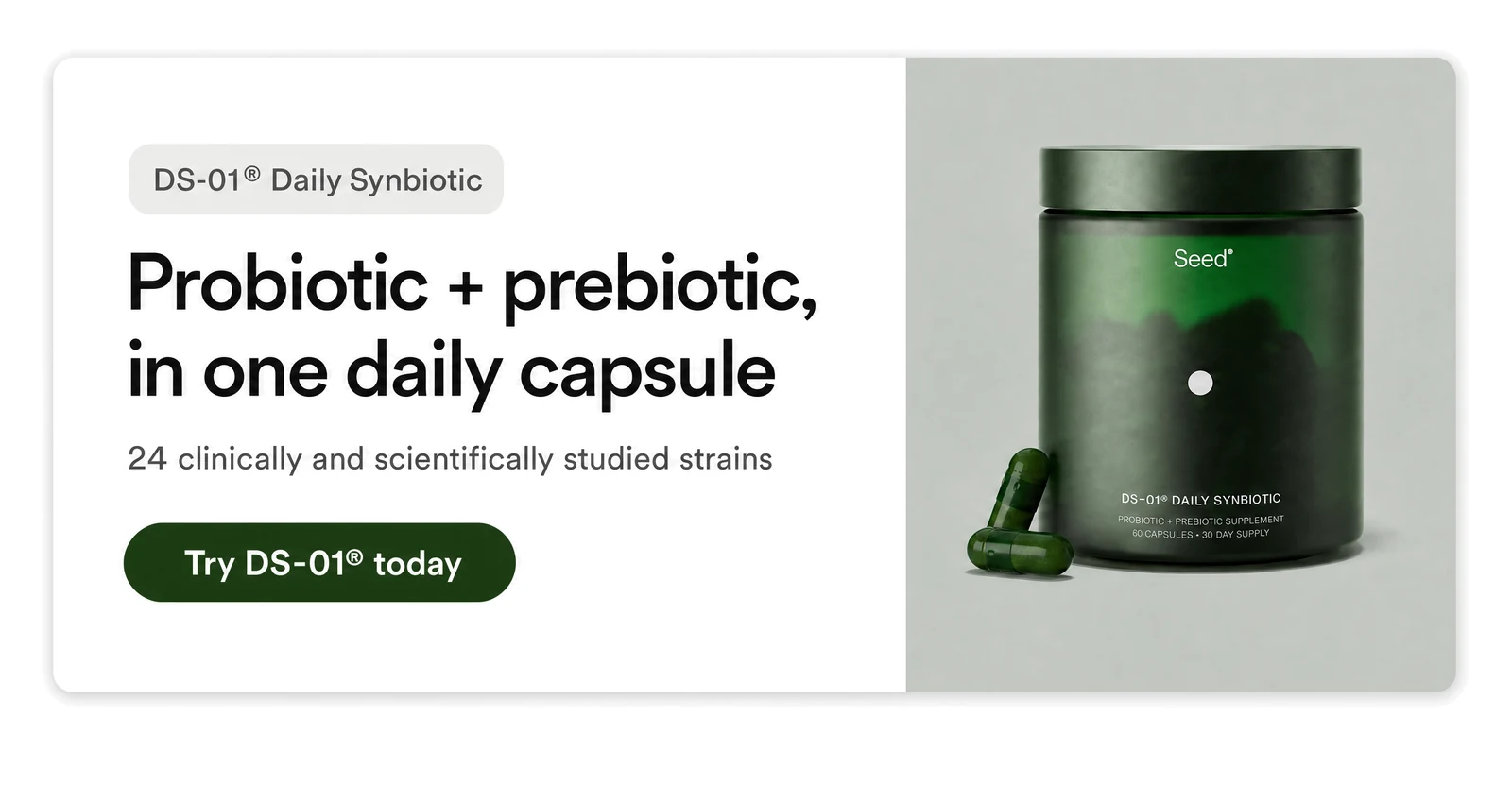
Its capsule-in-capsule delivery system, ViaCap®, delivers probiotics through digestion to the colon*°, a different mechanism than the live cultures you might find in food.
Neither approach replaces the other. A nutrient-rich diet and clinically studied probiotics work through different pathways, so if you’re adding one to your routine, check with your healthcare provider first.
Cottage cheese is a truly nutritious food. It’s packed with high-quality protein, calcium, and other nutrients that support your health in real, well-documented ways. If you choose a variety with live and active cultures, you may be adding some beneficial microbes to your diet too.
But the idea that cottage cheese is a reliable probiotic food is ahead of the evidence. Most of the gut health claims are based on individual ingredients, not on direct research into cottage cheese and your microbiome.1
Think of cottage cheese as good soil: it gives your body real, usable nutrition to grow from. But if you want a specific crop of gut benefits, you still need to plant the right seeds on purpose.
The smartest approach is to enjoy cottage cheese for what it genuinely offers: solid nutrition and versatility, while recognizing that targeted gut health support is its own category. Good health isn’t about finding one perfect food. It’s about understanding what different choices can do for you and making informed ones.
Good nutrition plants the seed, but knowing when to add something more targeted is what helps it grow. 🌱
Not in the way “probiotic” marketing suggests. Cottage cheese is nutritious, but no human clinical trials have studied it specifically for gut health outcomes.1
The benefits typically attributed to cottage cheese, like supporting digestion, come from its individual components, including casein and whey proteins, which have their own bioactive properties.3 If your cottage cheese contains live and active cultures, those microbes may offer some digestive support.
But the research is limited to animal and lab studies at this point. Cottage cheese is a great food choice, just don’t expect it to work like a clinically studied probiotic on its own.
For gut-specific benefits, yogurt has the stronger evidence base. It’s been studied for decades for its probiotic content and effects on the gut microbiome.
Cottage cheese, by contrast, has almost no direct human research on gut health outcomes.1 Where cottage cheese pulls ahead is protein: it can deliver more per serving than Greek yogurt.
The best approach is to include both for different reasons: yogurt for its studied probiotic potential, and cottage cheese for its protein and overall nutritional profile.
Neither, for most people. The relationship between dairy and inflammation isn’t as simple as you might expect. Some research suggests that fermented dairy products may have anti-inflammatory properties, partly due to bioactive peptides released during fermentation.
Casein and whey proteins in cottage cheese also have their own bioactive properties under investigation.3 For most healthy adults, cottage cheese is unlikely to cause inflammation.
If you have specific dairy sensitivities, it could contribute to digestive discomfort, but that’s a tolerance issue, not a true inflammatory response.
° These statements have not been evaluated by the Food and Drug Administration. This product is not intended to diagnose, treat, cure or prevent any disease.
µ As of February 2026.
* Based on a study conducted in SHIME®.



Overview Cottage cheese is everywhere right now. From high-protein breakfast bowls to viral recipes, it’s become a go-to for anyone paying attention to their health. Somewhere along the way, it also picked up a reputation as a gut health food. So is it actually good for your gut? Yes: cottage cheese is packed with protein,...
Overview If you’ve browsed the wellness aisle lately (or your social feed), you’ve probably seen probiotics and prebiotics making big promises for gut health. But when you’re choosing a synbiotic—a combination of both—the science matters as much as the label. Two that might catch your eye are Seed’s DS-01® Daily Synbiotic and The Nue Co....

Overview If your digestion seems to have a personality of its own (fine one week, completely unpredictable the next), you’re not imagining things. For many women, gut health shifts with hormonal changes in ways that feel random but actually follow a pattern. Your gut and your hormones stay in constant conversation. 😅 The microbiome (the...