Next Article
Soil-Based Probiotics: What the Research Actually Shows About Spore-Forming Strains
11 minutes
Kombucha is often celebrated for gut health, but the science is more nuanced. We explore how it affects the microbiome, how its microbes compare with clinically studied probiotic strains, and what research says about fermented foods versus targeted probiotics.

You’ve probably noticed kombucha taking over an entire refrigerator aisle at your grocery store. The fizzy, slightly tart fermented tea has gone from niche health food to mainstream staple, with global sales now in the billions. And if you’ve picked up a bottle, chances are gut health was the reason.
So is kombucha good for gut health? Yes, with caveats. Kombucha contains live microorganisms and organic acids that may support digestion.1 But understanding what kombucha can realistically do for your microbiome, and where it falls short, takes a closer look at the bottle, the studies, and the difference between a fermented beverage and a clinically studied probiotic. 🦠
Kombucha starts as sweetened black or green tea. It’s made by adding a SCOBY—a mix of bacteria and yeast that ferments the tea. Over 1-4 weeks, the yeast uses the sugar to make alcohol and carbon dioxide. Then, the bacteria turn the alcohol into natural acids, including acetic, lactic, and gluconic acid. These changes give kombucha its tangy taste and fizzy bubbles.2
What matters for your gut is what’s left after fermentation: live microorganisms, organic acids, polyphenols, and small amounts of B vitamins. The most common microbes are acetic acid bacteria (like Komagataeibacter) and yeasts (like Saccharomyces). Some kombuchas also contain lactic acid bacteria, including Lactobacillus—the same group of bacteria found in yogurt and some clinically studied probiotics. But the exact mix of microbes is different from one batch to the next.2
Scientists think some of kombucha’s potential benefits may come from the compounds created during fermentation. For example, acetic acid can help slow the growth of some microbes, and tea polyphenols have antioxidant properties. Researchers are also studying whether these compounds may affect inflammation, metabolism, and the gut microbiome.1
The catch is that kombucha is not a standardized product.The types and amounts of microbes can change depending on the SCOBY, the tea, the sugar used, and how long it ferments.2 That means every bottle is a little different, making it hard to know exactly which microbes it contains, how many are present, or how many survive the journey through your stomach.
🔬 Science Translation: Fermentation is a relay race in your bottle. Yeast turns sugar into alcohol, then bacteria turn that alcohol into the acids you taste. By the end, you’re drinking whatever those particular microbes left behind.
The research on kombucha and gut health is encouraging, but early. Here are the most relevant human trials.
A 2024 study published in Scientific Reports found that drinking kombucha daily changed the mix of bacteria living in the gut of healthy adults following Western diets. Researchers also saw signs that kombucha may support bacteria that produce short-chain fatty acids (SCFAs), compounds tied to gut health.3
Some studies have explored kombucha’s effects on blood sugar. One small study found that kombucha consumed alongside a carb-heavy meal produced smaller blood-sugar and insulin responses than control beverages.4
A 2025 systematic review concluded that kombucha “may provide health benefits,” while emphasizing that the evidence is still limited.5
👉 TL;DR: The direction is positive, but the evidence is small. Most studies used small groups and lasted a few weeks. Promising, but pilot-study territory.
Kombucha may provide what you might call microbial exposure. You’re introducing a diverse but unpredictable mix of organisms to your digestive system. That exposure has value: it contributes to microbial diversity, and diversity is generally associated with better overall gut and metabolic health.6 But microbial exposure and microbial intervention aren’t the same thing.
A targeted probiotic uses specific strains studied in clinical trials for specific health outcomes. Probiotic benefits are assessed at the strain level, so the data behind one strain can’t be transferred to another. Each strain is selected for a reason: support for digestive regularity, gut barrier integrity, immune signaling, or production of beneficial metabolites like short-chain fatty acids.
The dose is controlled. The strains are tested for survivability through digestion. The benefits are tied to the specific organisms at specific amounts.
Kombucha doesn’t offer any of that. Its microbial content varies between brands, batches, and even bottles from the same batch. The organisms weren’t selected for specific health outcomes, and survivability through stomach acid is uncertain for most of them.
There’s a meaningful distinction here. The microbial diversity you get from fermented foods isn’t the same as the precision of a clinically studied probiotic. Kombucha can be a great part of a gut-healthy diet, but it can’t replace a probiotic with strains selected and tested for specific outcomes. They serve different purposes.
👉 TL;DR: Kombucha feeds your microbiome variety. A clinically studied probiotic delivers specific results. Different jobs, different tools.
If kombucha offers variety, a targeted probiotic offers precision.
“There’s a meaningful distinction between the microbial diversity you get from fermented foods and the precision of a clinically studied probiotic,” says Dirk Gevers, Ph.D., Seed’s Chief Scientific Officer. “Kombucha can be a great part of a gut-healthy diet. But when people ask whether it can replace a probiotic with strains selected and tested for specific outcomes, the honest answer is that they serve different purposes.”
DS-01® Daily Synbiotic is one example of the targeted approach. It contains 24 live, scientifically studied probiotic strains, including a combination of L. plantarum LP and B. breve BR3 that has demonstrated improvements in bowel regularity and ease of evacuation.7
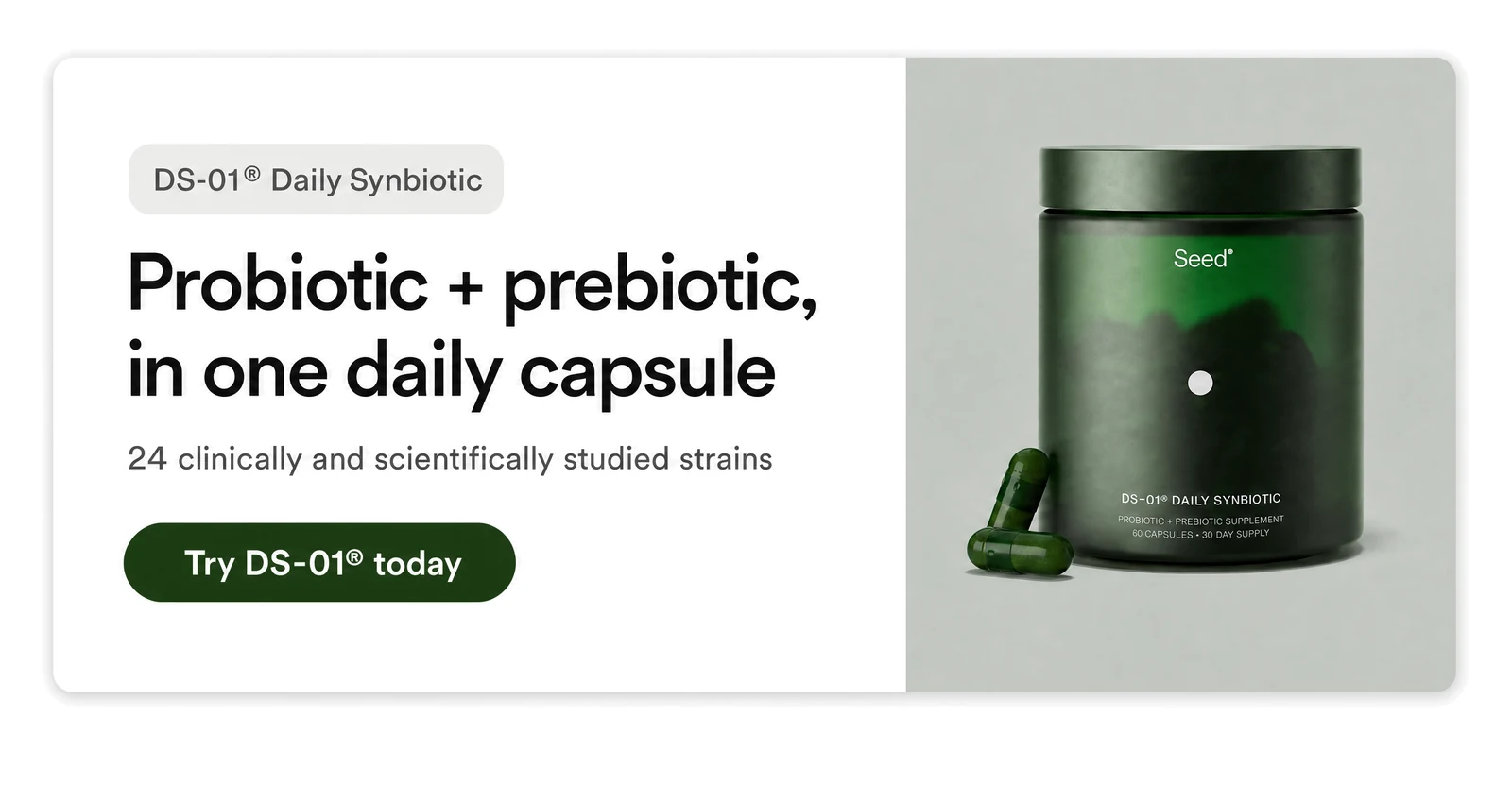
DS-01® has also been validated as a finished product. In a double-blind, randomized, placebo-controlled clinical trial, DS-01® was shown to support shifts in the gut microbiome and digestive health outcomes. Participants taking DS-01® experienced improvements in markers of digestive comfort, including reductions in the day-to-day impact of occasional bloating within one week in individuals with mild to moderate symptoms.8
Delivery matters too. DS-01®’s ViaCap® capsule-in-capsule design was tested with a Simulator of the Human Intestinal Microbial Ecosystem (SHIME) to confirm that viable cells reach the colon. At the three-hour mark, ViaCap® maintained about 100% of the starting dose through the end of the small intestine. That kind of precision is something fermented foods, however beneficial, simply can’t match.
If you enjoy kombucha, drink it. It’s a solid swap for sugary sodas (most kombucha has 5 to 8 grams of sugar per serving, compared to about 40 grams in a typical soft drink). The antioxidants and polyphenols from the tea base may contribute anti-inflammatory properties,1 and the organic acids may support a healthier gut environment.
A few practical tips:
If you’re pregnant, breastfeeding, immunocompromised, or have a sensitive digestive condition, check with your healthcare provider before adding kombucha to your routine. It’s unpasteurized, contains trace alcohol (some studies have found average alcohol content of about 0.77% ABV across commercial brands, with some exceeding 1%), and the acidity can be hard on certain stomachs. 😬
A good gut-health routine is a lot like a garden. Kombucha is one of the seeds you scatter. It adds live microbes, organic acids, and plant compounds that may help support a diverse gut microbiome. But because every batch is different, you can’t be sure which microbes you’re getting or how many are there. That’s not a drawback—it just means kombucha offers variety rather than precision.
The research on kombucha is still growing. So far, studies suggest it may lead to modest changes in the gut microbiome and support some aspects of digestive and metabolic health, but larger, longer-term studies are still needed. For people looking for support for a specific health outcome, clinically studied probiotics offer a different approach because they contain well-defined strains that have been researched for specific benefits.
🌱 A healthy gut grows from both the seeds you scatter and the ones you plant on purpose.
It depends. Kombucha and a probiotic do different jobs. Kombucha gives you broad microbial exposure: a diverse but variable mix of bacteria and yeast from fermentation. A clinically studied probiotic delivers specific strains at specific doses, tested for specific health outcomes.
No head-to-head clinical trial has compared the two directly. If your goal is general microbial diversity as part of a healthy diet, kombucha is a great choice. If you want targeted support for digestive regularity, gut barrier integrity, or gut-immune function, a probiotic with strains backed by clinical research is more appropriate. Many people use both, and there’s good reason to.6
Daily, for at least a few weeks. The clinical trials that showed measurable shifts in gut microbiota used daily consumption.3 If you’re new to kombucha, start with 4 ounces a day for the first week.
For ongoing support, 8 ounces per day is a reasonable target — about half a standard bottle. Going above 12 ounces daily increases your risk of digestive discomfort and excessive sugar or acid intake. Consistency matters more than volume.
Acidity, variable sugar, and unpredictable microbial content. Kombucha’s low pH can erode tooth enamel if you sip it slowly throughout the day, so drink it in one sitting and rinse with water afterward. Sugar varies widely between brands, from near-zero to 19 grams per serving, so always check the label. Gas and bloating are common in the first week.
Microbial content is unpredictable, with no strain specificity or standardized dosing.2 Actual alcohol content can also be higher than labels suggest, with some commercial samples exceeding 1% ABV. People who are pregnant, breastfeeding, or immunocompromised should avoid it entirely.
Pregnant and breastfeeding women, immunocompromised people, and young children. Pregnant and breastfeeding women are generally advised to skip kombucha because it’s unpasteurized and contains trace alcohol and caffeine. People with compromised immune systems should avoid it due to the raw, diverse microbiology. Children under 4 aren’t recommended to have it either.
If you have a sensitive stomach, start very small (2 ounces), since fermentation byproducts and kombucha’s low pH can cause irritation for some people. When in doubt, talk to your healthcare provider.


Overview You’ve probably heard that fermented foods are good for your gut. Yogurt, kimchi, sauerkraut, kombucha: they show up on every “gut health” list you’ll find. And the general advice is pretty straightforward. Eat more of them. But not every jar of sauerkraut on the shelf actually contains live microbes. And even when fermented foods...

Overview Gut health is trending—and not without reason. The trillions of microorganisms in your digestive tract play key roles in digestion and immunity, and they’re being studied for links to mood and even skin health. But with all the noise around “fixing” your gut, it’s easy to feel overwhelmed. Your gut microbiome (probably) isn’t broken....

There’s an invisible world in, on, and all around us. In celebration of the release of bio-artist Tal Danino’s book Beautiful Bacteria, here is a selection of stunning microbes to feast your eyes on.