Next Article
Can Probiotics Help With Depression? Your Gut May Have a Say
7 minutes
What is a synbiotic? It's a probiotic and prebiotic combination that has been tested together in people. See how synbiotics differ from probiotics and prebiotics, the two types, real studied examples, and what human research has and hasn't found.

Gut health has gone mainstream—and so has the jargon. Probiotics? Household name. Prebiotics? They’re popping up everywhere, from sugar-free sodas to TikTok trends. Just when you think you’ve got it sorted, in struts “synbiotic.” Is this just a fancier way to sell you a 2-in-1 capsule, or is there real science behind the label?
In a nutshell, a synbiotic is a formulation that combines probiotics and prebiotics. But it goes deeper than that. Imagine your gut as a dinner party: probiotics are the guest chefs—specialists invited to bring something extra. Prebiotics are the ingredients and recipes that help those chefs do their thing. A synbiotic is a well-planned party where every guest is matched with their perfect dish, ensuring a smooth, memorable evening (and fewer awkward silences). 🍽️
So how can you tell a true team-up from marketing spin? It comes down to one thing: whether the combination itself has been tested in people.
Probiotics and prebiotics are often paired together, but they play distinct roles.
Probiotics are defined as “live microorganisms that, when administered in adequate amounts, confer a health benefit on the host.”1 In other words, they’re living microbes—usually specific strains of bacteria—that help your body in science-backed ways. The number of microbes in a probiotic dose will be listed on the label, measured in either CFU (colony forming units) or AFU (active fluorescent units).
There’s a common myth that probiotics set up permanent residence in your gut, changing your microbiome for good. The reality is that most probiotics are more like guests who visit, interact, and eventually leave (yes, out the other end).2 That’s why daily, consistent use is important if you want to keep their benefits going. 🦠
Prebiotics, on the other hand, are not alive. Scientists call them “a substrate that is selectively used by host microorganisms, conferring a health benefit.”3 In plain language: they’re specific dietary fibers or compounds, such as polyphenols, your gut bacteria love to snack on.
When your gut microbes digest prebiotics, they churn out helpful little molecules like short-chain fatty acids (SCFAs). These help reinforce your gut lining and even play a role in how your gut “chats” with your brain.4 Basically, by eating more prebiotics, you’re fueling the resident bacteria that support everything from digestion to systemic health.
A synbiotic is “a mixture comprising live microorganisms and substrate(s) selectively used by host microorganisms that confers a health benefit on the host.”5 Or, less formally: it’s a purposefully crafted combo of probiotics and prebiotics, designed to work together in ways that support your health.
But there’s a catch: probiotic + prebiotic ≠ synbiotic. Mixing the two in one product doesn’t make it a true synbiotic. To use the term “synbiotic,” the final blend must have human clinical evidence that it delivers real, measurable benefits.
The most important distinction is how the probiotic and prebiotic are meant to interact. That difference shapes what you can expect from the product.
You’ll see plenty of products with “probiotic + prebiotic” on the label, but not all are created equal. Science recognizes two main categories: complementary and synergistic synbiotics.
Complementary synbiotics are the most common type. Here, you’ve got a clinically studied probiotic and a clinically studied prebiotic—each one brings benefits, but they work mostly independently.
What sets a complementary synbiotic apart isn’t just having both in the same product—it’s that the combination itself has been tested together in human trials and shown to provide benefits as a team.5 The prebiotic isn’t selected for a specific probiotic, but both support your gut side by side. Picture a buddy cop movie: different approaches, shared goal, and better results when they’re actually working the same case.
Synergistic synbiotics are the power couple. In these blends, the prebiotic is chosen because it’s the ideal fuel for the specific probiotic it’s paired with.5 This pairing is designed so that the prebiotic helps the probiotic survive, grow, and provide benefits it couldn’t on its own—delivering more impact than you would from either ingredient alone.
That level of intention is what separates a thoughtfully designed synbiotic from a basic probiotic-plus-prebiotic blend. And, just like with complementary synbiotics, the entire blend must be tested together in humans to prove it actually delivers those extra benefits. 🧪
So what does a tested team-up actually look like? Here are three probiotic + prebiotic pairings that researchers have studied together in people.
Your plate can get you partway there. Fermented foods like yogurt or kefir may contain live cultures, though the amounts vary by product and processing.9 Pair one with fiber-rich foods like oats, bananas, onions, or garlic, and you bring cultures and fiber together. That’s a tasty habit. But these are untested food pairings: no one has studied these combos as synbiotics. A synbiotic has to be shown to benefit health as a combination.5 🥣
Each row below is one human study or pooled review. A randomized controlled trial (RCT) compares a synbiotic with a placebo. A meta-analysis pools many trials—basically, a study of studies.
| Synbiotic studied (strains + prebiotic) | Study type | Population | Outcome measured | Result |
|---|---|---|---|---|
| B. lactis and L. rhamnosus strains with FOS. | RCT, 8 weeks.6 | 106 healthy adults. | Immune markers, including stool secretory IgA (not infections). | Higher stool secretory IgA than placebo. |
| Different synbiotics (reported apart from prebiotics). | Systematic review and meta-analysis of RCTs.10 | Adults. Children were looked at separately. | C-reactive protein (CRP), an inflammation marker. | Lower CRP in adults. No effect in children. |
In one RCT, 106 healthy adults took a synbiotic or a placebo for 8 weeks. The synbiotic group had more secretory IgA, an antibody your body releases into your gut, in their stool.6 That’s an immune marker, though, not a count of colds or infections.
A review that looked at synbiotic trials separately found lower CRP in adults and no effect in children.10 If you’re managing a health condition, talk with your healthcare provider.
Results apply to the specific formulation and the people studied. They don’t carry over to other synbiotics. That’s why the combination itself has to be tested.5 An umbrella review (a review of many reviews) found that effects varied by strain, by who was studied, and by health condition. Its trials were also too different to compare easily.11 Human research on synbiotics is still growing.
🔬 Science Translation: The positive findings so far are changes in markers measured in blood or stool, and each one belongs to the specific combo tested.
No matter the type, synbiotics do more than just combine benefits—they set the stage for teamwork in your gut through several mechanisms.
Your digestive tract is an obstacle course of acid baths, bile salts, and rapid pH swings. In some synbiotics, the prebiotic is picked to fuel its paired probiotic—like trail mix for microbes.5
Certain fibers or polyphenols may buffer stomach acid, help bacteria regulate their own stress-response genes, and even jump-start growth along the way. For you, that can mean more viable cells arrive where they can get to work instead of being lost to stomach turbulence.
But arriving isn’t the same as moving in. The paired prebiotic is meant to help a probiotic survive and stay active as it passes through, not to stay for good. It’s the same guest dynamic as before: probiotics visit, interact, and eventually leave. In one trial in healthy adults, the added microbes showed up in stool for days after people stopped taking them, then faded.12 Even the definition of a synergistic synbiotic only asks that the added microbes use their paired prebiotic, not that they stay.5 That’s why consistent use matters.
Probiotics can’t do it all on their own—they need raw materials. When gut microbes metabolize prebiotics, they create short-chain fatty acids such as butyrate, acetate, and propionate. Those SCFAs reinforce your intestinal lining, regulate appetite hormones, and may help keep inflammation in check.4
A well-designed synbiotic supplies both the bacterial “builders” and the biochemical “bricks,” which can boost output of these health-supportive metabolites. The goal is a gut ecosystem that communicates more effectively with your immune, metabolic, and even nervous systems.
Think of your gut as a crowded marketplace. Pathogens can set up shop when stalls go empty. Synbiotics can tip the economy: probiotics compete for nutrients and real estate, while prebiotics selectively feed resident allies.13
Over time, this cooperative pressure can nudge your microbiome toward greater diversity and stability, making it better equipped to support digestion, immune function, and more. (Yes, your microbes hold that much sway.) 💪
Most people picture prebiotics as fibers like inulin or fructooligosaccharides (FOS), which you’ll find in foods like onions or chicory root. While these are great for short-chain fatty acid production, they can also cause gas and bloating in some people.
What if a prebiotic didn’t have to be a typical “fiber”? What about a raw material that only certain gut microbes could transform into compounds your body can use?
That’s the thinking behind the DS-01® Daily Synbiotic. Instead of fiber, it uses Microbiota-Accessible Polyphenolic Precursors™ (MAPP)—compounds from Indian pomegranate, rich in punicalagins (a type of polyphenol). These aren’t digested like fibers; instead, specific gut microbes turn them into unique metabolites called urolithins. DS-01® supports production of healthy gut metabolites°.8
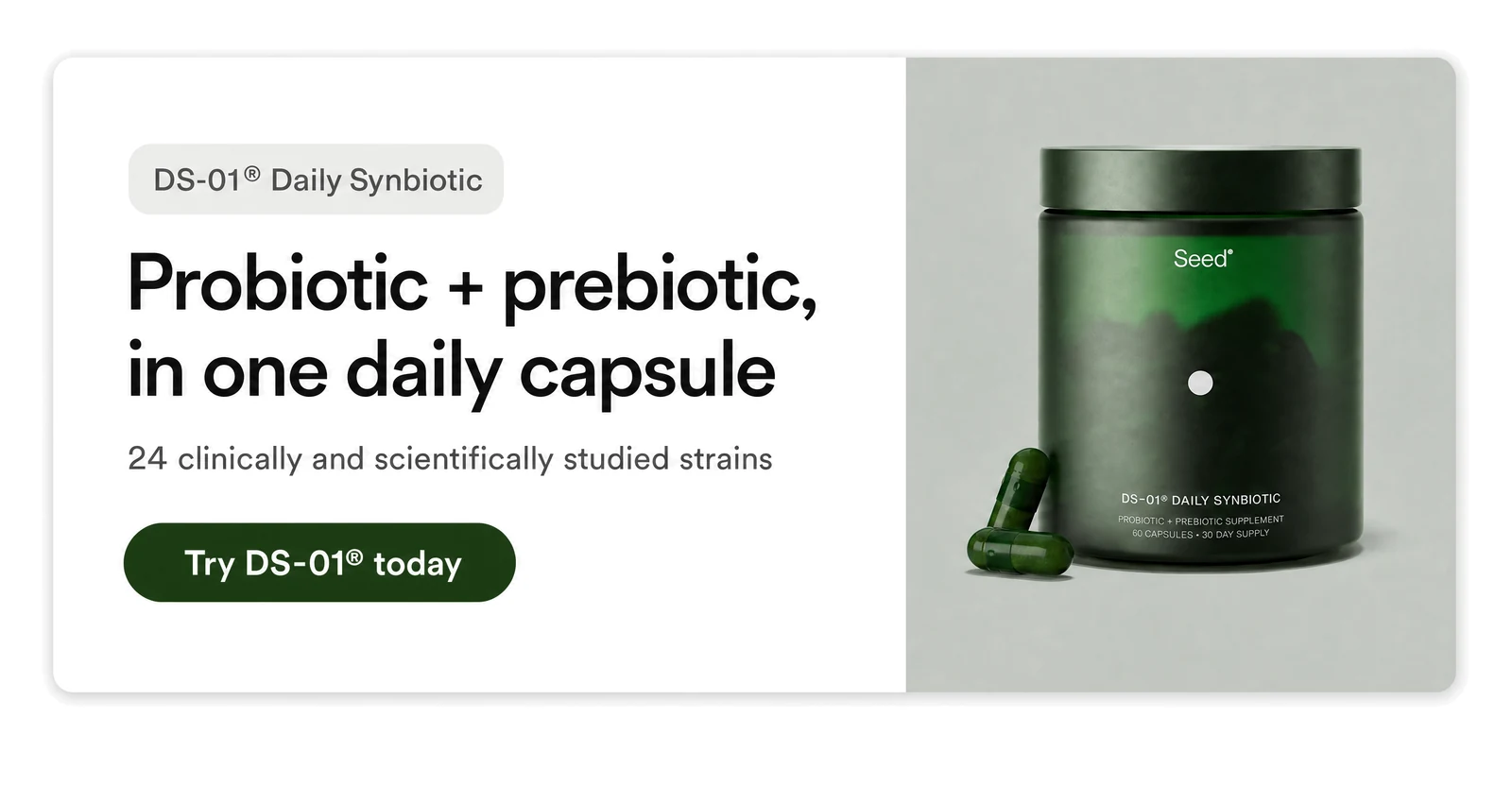
DS-01® is a 2-in-1 probiotic and prebiotic, with a polyphenol, non-fiber prebiotic from Indian pomegranate. It’s clinically shown to reduce bloating + gas°.14
As Dirk Gevers, Ph.D., Seed’s Chief Scientific Officer, explains, “At Seed, when we talk about a synbiotic like DS-01®, we’re referring to a precisely designed combination. DS-01® pairs 24 clinically and scientifically studied probiotic strains with our novel, non-fermenting polyphenol-based prebiotic. This isn’t just a mix; it’s a formulation where the components are intended to work together.”
What is a synbiotic, really? It’s not just a clever blend or a marketing ploy. True synbiotics are scientifically defined combinations of probiotics and a prebiotic fuel, tested together in people. The split between complementary and synergistic synbiotics reflects a move toward precision in microbiome science. And because results belong to the formulation tested, what separates a true synbiotic from a generic blend is research on that exact combination.
Supporting your gut microbiome isn’t about quick fixes or shortcuts. It’s about cultivating an ecosystem where the right microbes get the right support, and everything works together to help you thrive.
🌱 Good health is cultured—and sometimes, it’s a team effort.
A probiotic consists of live microbes themselves, while a synbiotic is an evidence-backed combination of probiotics and prebiotics. A probiotic delivers helpful bacteria; a synbiotic gives those bacteria the fuel they need to thrive. In other words, a synbiotic is a science-backed way to help your gut’s “good guests” do their best work.
Synbiotics have been studied in people for immune and inflammation markers—and each result belongs to the formulation tested. One RCT in healthy adults found more stool secretory IgA, an immune marker.6 Synbiotic trials in adults also found lower CRP, an inflammation marker.10
You can, but the combo won’t be clinically validated as a unit. Taking a proven probiotic with a separate, well-studied prebiotic can still be beneficial. The trade-off is precision: without human data on the exact pairing, you won’t know if the ingredients truly amplify one another or simply work in parallel.
°These statements have not been evaluated by the Food and Drug Administration. This product is not intended to diagnose, treat, cure, or prevent any disease.



Fruit is packed with polyphenols but also high in sugar—so where does it net out for your gut? Here’s a breakdown of the five best fruits for gut health and how to enjoy them.

Overview You start a probiotic to support your gut—maybe for digestion, regularity, or just to feel like you’re doing something good for your health. But then something unexpected happens: your jeans feel snug, the scale creeps up. It’s a common experience that often leads to the question: Can probiotics cause weight gain? The complicated answer?...
Overview You start a probiotic to support your gut—maybe for digestion, regularity, or just to feel like you’re doing something good for your health. But then something unexpected happens: your jeans feel snug, the scale creeps up. It’s a common experience that often leads to the question: Can probiotics cause weight gain? The complicated answer?...