Next Article
Seed’s DS-01® vs. Grüns: Synbiotic Capsule or Nutritional Gummy?
13 minutes
Trying to choose between Seed vs Arrae vs ARMRA? Here's the science, survivability, and formulation behind three popular gut-health products—from targeted probiotic strains to a multi-biotic blend to bovine colostrum—so you can find the approach that fits your body.

You’ve probably been there: scrolling your feed or standing in the wellness aisle, a little overwhelmed by how many gut health products are fighting for your attention. Powders, capsules, gummies—each one promising to fix your digestion. You’re not the first to wonder which ones actually have science behind them and which are leaning on good marketing.
Most labels are heavy on Latin and light on answers. So if you don’t fully know what you’re buying, that’s not a you problem—it’s an industry problem. 🦠
We’re taking a close look at three popular but genuinely different products: Seed’s DS-01® Daily Synbiotic, Arrae Tribiotic, and ARMRA Colostrum. They might all show up under the “gut health” umbrella, but what they do inside your body varies a lot. By comparing their ingredients, how they’re delivered, and the science behind them, you can make an informed call for your own microbiome.
Before we compare the three head-to-head, it helps to realize they don’t actually belong in the same category. Picture your gut microbiome as a garden. Each product tends it a different way.
A synbiotic (like Seed’s DS-01®) is a combination of probiotics and prebiotics working together. In garden terms, it supplies both the beneficial seeds (probiotics) and the targeted fertilizer (prebiotics) that help them do their job.
A “tribiotic” (a term used by products like Arrae) usually means a mix of prebiotics, probiotics, and postbiotics. Postbiotics are inanimate microbes or their byproducts. If probiotics are the seeds and prebiotics are the fertilizer, postbiotics are like compost—they don’t grow into new plants, but they still interact with the soil to support the ecosystem.
Colostrum (like ARMRA) is a different thing entirely. It isn’t a probiotic and contains no live strains. It’s the first milk mammals produce after giving birth—a whole-food concentrate rich in antibodies, growth factors, and early-life nutrients. Back to the garden, colostrum is more like a nutrient-dense topsoil meant to fortify what’s already there than a packet of new seeds.
👉 TL;DR: Seed is a synbiotic (microbes plus their food), Arrae is a “tribiotic” blend with an animal-derived binder, and ARMRA is dairy-derived colostrum with no live microbes. Same shelf, different jobs.
| Feature | Seed’s DS-01® Daily Synbiotic | Arrae Tribiotic | ARMRA Colostrum (Unflavored) |
|---|---|---|---|
| Product Category | Synbiotic (Probiotic + Prebiotic) | “Tribiotic” + Immunoglobulins | Bovine Colostrum Powder |
| Probiotic Strains | 24 highly characterized strains | 8 bacterial strains + 1 spore | None (0 live strains) |
| Total Potency | 53.6 Billion AFU | 50 Billion CFU | N/A |
| Prebiotics | Non-fermenting MAPP™ from Indian pomegranate | Fermentable XOS (Xylooligosaccharide) | Milk oligosaccharides |
| Postbiotics | Produced naturally in the gut (e.g., urolithin A) | Heat-treated B. longum CECT7347 | N/A |
| Delivery Technology | ViaCap® 2-in-1 nested capsule | Standard vegetable capsule | Loose powder / Stick packs |
| Scientific Research Focus | Finished-product human clinical trials | Ingredient-level studies | Primarily in vitro (cell-based) research |
| Price (per 30-day supply) | $49.99 | $49.00 | $119.99 (120 servings) or $43.99 (30 sticks) |
Seed’s DS-01® takes a strain-specific, research-first approach. Rather than a random assortment of bacteria, DS-01® is a clinically studied synbiotic focused on digestive health—supporting regularity and easing occasional bloating and gas.
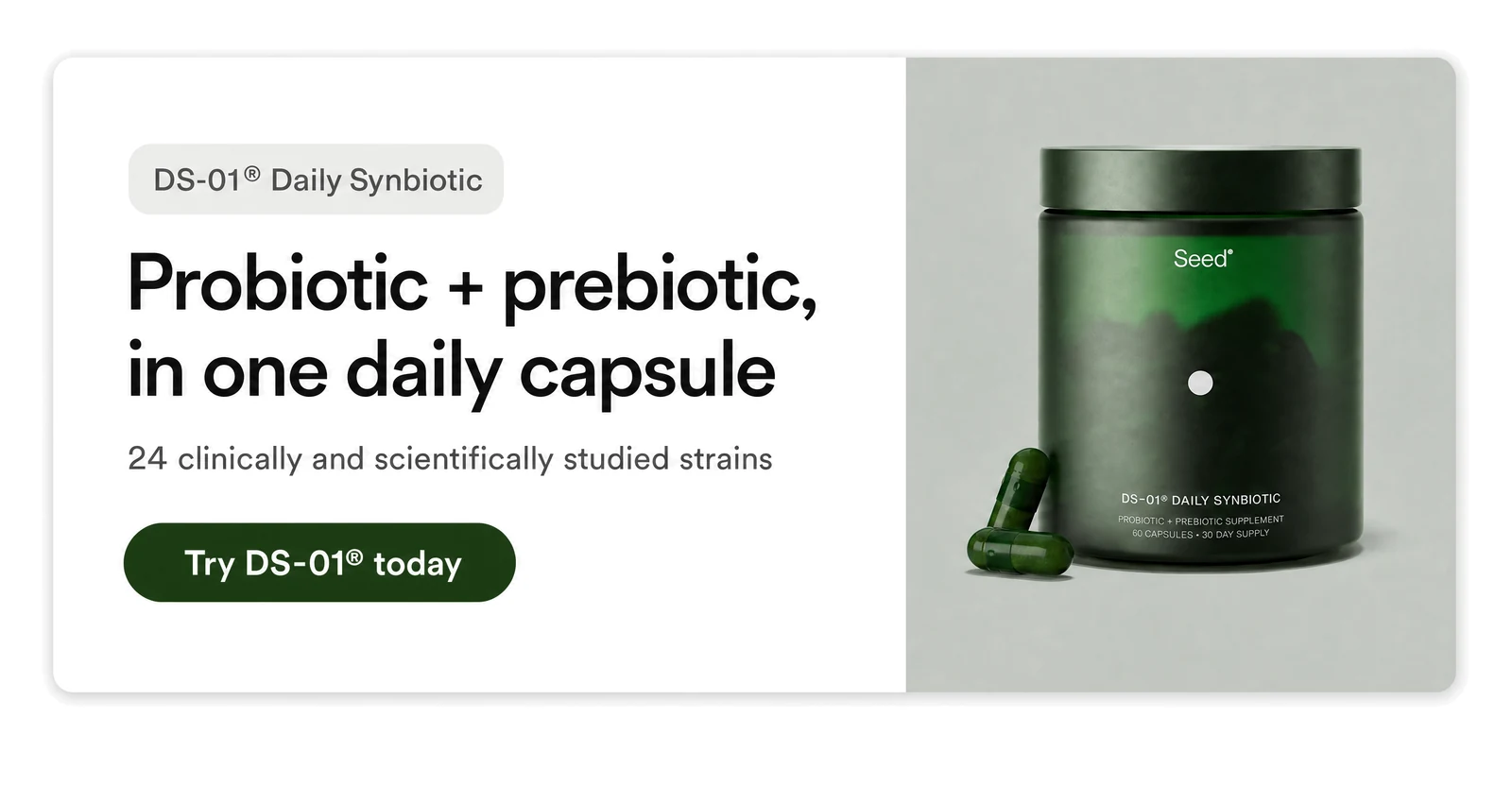
DS-01® contains 24 distinct probiotic strains from the Lactobacillus and Bifidobacterium genera. When you’re evaluating probiotics, specificity matters.
Grabbing a bottle that just says Lactobacillus is like going to a shelter and asking for “a dog”—the details matter. Seed names the exact strains it uses, each chosen based on human clinical data showing how it interacts with your body.
Because Seed leans on strain-specific research, DS-01®’s digestive benefits come with a few studied secondary ones:
On most labels you’ll see a CFU (Colony Forming Units) count. Seed’s DS-01® uses AFU (Active Fluorescent Units). Why the different acronyms? Because they count in different ways.
AFU is measured with flow cytometry, a precise technique that tags viable cells with fluorescent markers. It counts all the live, active bacteria—including those that might not form a visible colony on a petri dish but are still effective in your gut.
🔬 Science Translation: CFU counts the bacteria that grow into visible colonies on a dish. AFU uses lasers to count every live cell, including ones that are active but don’t form colonies—so it captures viability a plate can miss.
Many prebiotics rely on fermentable fibers. Those feed bacteria, but fermentation often produces gas, which can cause bloating. DS-01® uses Microbiota-Accessible Polyphenolic Precursors™ (MAPP), a non-fermenting prebiotic from 400mg of whole-fruit Indian pomegranate. Your gut microbes biotransform these polyphenols into beneficial metabolites without the uncomfortable gas.4
Probiotics are living organisms, and stomach acid is built to break them down. DS-01® uses ViaCap® technology—a capsule nested inside another capsule.
The outer capsule holds the pomegranate prebiotic and shields against oxygen, moisture, and heat. The inner capsule protects the 53.6 billion AFU of live probiotics so they survive the stomach and arrive in the colon, where they do their best work.
Seed’s rigor extends to the environment. Your first month includes a refillable glass jar and a glass travel vial. After that, refills arrive in compostable, bio-based pouches, cutting single-use plastic out of your routine.
DS-01® isn’t just a collection of ingredients with borrowed science. The finished formula has been tested in the Simulator of the Human Intestinal Microbial Ecosystem (SHIME®) for survivability, and it’s the subject of double-blind, randomized, placebo-controlled human trials testing its real-world effects.
🌱 Learn more about Seed’s DS-01 Daily Synbiotic →
Arrae Tribiotic positions itself as an all-in-one daily product for women, aiming to support gut, vaginal, immune, and skin health at once. It combines several types of “biotics” with an animal-derived binder for a broad-spectrum approach. Here’s how the formula is built.
Arrae Tribiotic provides 50 billion CFU from a proprietary blend of eight bacterial strains and one spore, Bacillus subtilis Bss-19.
Listing specific strain designations is a plus. One trade-off of a “proprietary blend,” though, is that the dose of each individual strain isn’t disclosed—so you know the total count but not whether any single strain is at a clinically studied amount. The blend also includes a spore-forming organism (B. subtilis), a soil-based bacterium.
Spore-based ingredients are increasingly popular, and the research on them is still growing—there’s less clinical consensus so far, and more study is needed on their long-term effects across different populations compared with more extensively researched strains like Lactobacillus and Bifidobacterium.5
To round out the “tribiotic,” Arrae includes 400mg of xylooligosaccharide (XOS) as its prebiotic fiber. XOS is a non-digestible carbohydrate that feeds your gut bacteria. Feeding your microbes is a good thing, but XOS is highly fermentable—as microbes break it down, fermentation can produce gas. If you’re already sensitive, adding more fiber may cause bloating or discomfort.6
For the postbiotic, Arrae includes 25mg of heat-treated B. longum CECT7347 (ES1 HT). Postbiotics are inanimate microbes that, though no longer alive, can still interact with your immune receptors. They don’t travel through your system doing tasks the way live probiotics do, but they offer structural components your immune system recognizes.
Beyond the “biotics,” Arrae includes 250mg of ImmunoLin®, a standardized bovine immunoglobulin concentrate that provides 126mg of IgG.
In plain terms, IgG is a cow-derived antibody—a Y-shaped immune protein that latches onto specific targets. Here it’s meant to bind and help clear certain microbial particles in the gut. Because it comes from cow serum, Arrae Tribiotic isn’t fully vegan and isn’t suitable for a plant-based or dairy-free diet. The inactive ingredients are a vegetable capsule, organic rice concentrate, and an organic rice extract blend.
Based on their product literature, Arrae says the formula:
Disclaimer: These claimed benefits do not reflect Seed’s claims
Arrae uses a standard vegetable capsule. It’s a clean, common delivery method, though standard capsules tend to break down quickly in the stomach. Without targeted or delayed-release technology, the live strains can be exposed to stomach acid and digestive enzymes, which may reduce how many survive the trip to your lower intestine.7
Arrae points primarily to ingredient-level studies—research on individual components like XOS, ImmunoLin®, or isolated strains—rather than human clinical trials on the finished 3-in-1 Tribiotic itself. Ingredient science is a reasonable starting point, but it doesn’t guarantee how those ingredients perform once combined in a single capsule and taken by a person.
ARMRA has drawn a lot of attention as a daily powder for fortifying the body’s barriers. The key thing to know is that ARMRA isn’t a probiotic—it works through a different biological mechanism, using a dairy-based whole-food concentrate.
ARMRA Colostrum contains zero probiotic strains—it isn’t a probiotic product. Colostrum is the first milk mammals (in this case, cows 🐮) produce right after giving birth. Nature designs it to give a newborn calf its initial immune blueprint and early nutrition.
ARMRA’s philosophy is that humans can benefit from these bovine compounds to strengthen their own mucosal barriers. The company uses a proprietary “Cold-Chain BioPotent™” process to extract the colostrum, removing fat and casein (a milk protein many people are sensitive to) while concentrating the remaining bioactive molecules.
While it has no live bacteria, bovine colostrum is naturally rich in milk oligosaccharides. These fiber-like carbohydrates act as prebiotics in the human gut. They’re valued because they selectively feed certain beneficial bacteria, especially in the Bifidobacterium genus, helping them thrive while discouraging less favorable microbes.8
Beyond prebiotics, colostrum contains immunoglobulins (IgG, IgA, IgM—the antibodies your immune system uses to tag targets), lactoferrin, growth factors, and peptides. These interact with the mucosal lining of your gut and your immune cells. Rather than adding new microbial workers, ARMRA provides structural building blocks and antibodies meant to support your existing cellular architecture.
The Unflavored Jar of ARMRA contains no other active or inactive ingredients—just proprietary bovine colostrum concentrate. It is an animal-derived dairy product, though. Even with casein and fat removed, it still contains milk, so it isn’t vegan or dairy-free, and anyone with a severe dairy allergy should approach it with caution.
According to their product information, ARMRA says its colostrum concentrate:
Disclaimer: These claimed benefits do not reflect Seed’s claims
ARMRA comes as a loose powder in a jar or stick packs, dry-scooped into your mouth or mixed into cool liquid. Because it’s a loose powder, it hits your stomach right away. Without a protective capsule or delivery system, the delicate bioactive compounds, peptides, and immunoglobulins meet the acidic stomach environment directly.
Colostrum has some natural protective qualities, but getting through human gastric acid without an engineered delivery system can degrade these compounds before they reach the intestines.7
ARMRA often points to research suggesting its colostrum helps regenerate the gut barrier and outperforms competitors. It’s worth understanding how that research is run: many of these figures come from in vitro studies—testing on isolated cells in a lab rather than inside a living person. Lab testing is an important starting point, but a dish can’t fully replicate the complex environment of human digestion.
Comparing Seed’s DS-01®, Arrae Tribiotic, and ARMRA Colostrum really comes down to three different philosophies of support.
If you want a dairy-based whole-food approach that provides immune building blocks and prebiotics, ARMRA offers a high-quality concentrate—just remember it isn’t a probiotic, and the loose-powder format means those delicate compounds brave your stomach acid unprotected.
If you prefer a multi-pronged approach and don’t mind animal-derived ingredients or highly fermentable fibers, Arrae Tribiotic combines live bacteria, inanimate postbiotics, and bovine immunoglobulins—though the proprietary blend hides the exact strain doses, and the standard capsule leaves live microbes more exposed during digestion.
If you want a vegan formula built on precision and clinical rigor, Seed’s DS-01® stands out. It pairs 24 characterized, clinically studied strains with a non-fermenting prebiotic to support daily digestive health without the gas that fermentable fibers can cause—and the ViaCap® system helps those living organisms actually reach your colon.
The wellness aisle doesn’t have to feel like a guessing game. Arrae and ARMRA offer genuinely interesting compounds—postbiotics, soil-based spores, bovine colostrum—but they lean on ingredient-level or lab-based evidence rather than finished-product human trials, and their delivery is less engineered for survivability.
Knowing the difference between a proprietary blend in a standard capsule and a clinically studied formula in a precision-release system is what lets you choose based on your biology instead of the packaging.
🌱 In a market full of promises, clarity is rare. Choose what’s seeded in science.
Yes, generally you can. They do different jobs—probiotics add live, beneficial microbes while colostrum provides dairy-derived antibodies and early-life nutrients—so they don’t cancel each other out.
If you have a sensitive stomach, starting two new products at the exact same time might cause some temporary adjustment. It’s a good idea to check with your healthcare provider before combining new supplements.
A synbiotic is an established scientific term for a product with both probiotics (live microbes) and prebiotics (the food they need) working together. “Tribiotic” is mainly a term used by some brands to signal a third element, usually a postbiotic (inanimate microbes or their byproducts).
Worth noting: a healthy gut fed a quality synbiotic will naturally produce its own beneficial postbiotics right inside your digestive tract.
They can, but it depends on the type. Many products use fermentable fibers (like the xylooligosaccharide in Arrae). When gut bacteria eat these fibers, fermentation creates gas as a byproduct—often leading to bloating.
Non-fermenting prebiotics, like the punicalagins in the Indian pomegranate extract used in Seed’s DS-01®, are biotransformed by your microbes without that gas.
💡 Pro Tip: If fermentable fibers tend to leave you bloated, a non-fermenting prebiotic (like pomegranate polyphenols) can be gentler on your gut while still feeding your microbes.


Overview The probiotic aisle can be a lot — bold branding, “super strain” claims, and more “biotics” than anyone can keep straight. If you’ve narrowed it down to Seed’s DS-01® and Ritual Synbiotic+, here’s a straight side-by-side with the science behind each. 🦠 Both are synbiotics built to support your gut microbiome, but they take...

Overview Welcome to the comparison you didn’t know you needed—but your gut definitely does. You’ve probably seen countless options lining the shelves (or filling your social feeds), and two names that keep coming up are Seed’s DS-01® Daily Synbiotic and Visbiome. Both have scientific street cred, but here’s the thing: they’re playing completely different games....

Overview Gut health is having a moment, and the shelves show it — rows of “biotic” blends all promising a calmer, healthier gut. Two you’ll run into often are Seed’s DS-01® Daily Synbiotic and Klora Gut-Renew. Both say they support your gut, but they’re closer to apples and oranges: one is built around live probiotic...