Next Article
Seed’s DS-01® vs Arrae Tribiotic: Which Gut Health Ally Is Right for You?
10 minutes
Seed's DS-01® Daily Synbiotic and ARMRA Colostrum take two very different paths to gut health. We break down live microbes versus passive animal bioactives—their delivery, ingredients, and clinical backing—so you can choose the right ally for your microbiome.

Gut health gets a lot of airtime right now, and if you’re trying to actually do something about yours, you’ve probably run into two very different camps: live synbiotics and bovine colostrum. If you’ve stood there wondering which one makes sense for your body, you’re in good company.
We’ve all done the same thing—multiple tabs open, trying to tell the science apart from the marketing. (Spoiler: they are not the same thing.) 🦠 So before you pick, it helps to know exactly what you’re comparing.
Seed’s DS-01® Daily Synbiotic gives you living, transient microbes plus plant-based prebiotics that travel to your colon and get to work—making helpful compounds and interacting with the microbes you already have. ARMRA Colostrum gives you pre-formed animal bioactives (think antibodies and growth factors) from the first milk cows make after giving birth.
Both want to support your intestinal lining and overall well-being. But their methods, delivery, and scientific backing aren’t in the same ballpark. Let’s look at how they actually stack up.
Before we get into specifics, it helps to nail down the basic difference between these two categories.
A synbiotic (like DS-01®) pairs probiotics with prebiotics. Probiotics are live microorganisms that, taken in the right amounts, can offer a health benefit. Prebiotics are the specific food those microbes feed on to make helpful byproducts—including short-chain fatty acids (SCFAs), the compounds that feed the cells lining your gut and help keep your immune signaling steady.1
🔬 Science Translation: Think of prebiotics as groceries and probiotics as the cooks. The cooks turn the groceries into SCFAs—small molecules your gut lining uses for fuel and repair. A synbiotic just ships the cooks and the groceries together.
Bovine colostrum (like ARMRA) is not a probiotic. It doesn’t contain living bacteria meant to mingle with your microbiome. It’s the very first milk dairy cows produce right after giving birth, and it’s naturally loaded with immunoglobulins like IgG (antibodies that tag and neutralize invaders), antimicrobial peptides (small proteins that can disrupt microbes), and growth factors (chemical signals that tell cells to grow and repair)—all meant to jump-start a newborn calf’s immune system and gut barrier.2
When you take it as a powder, the idea is for those ready-made animal compounds to passively coat and support your own gut lining.
| Feature | Seed’s DS-01® Daily Synbiotic | ARMRA Colostrum (Unflavored Jar) |
|---|---|---|
| Product Category | Synbiotic (Probiotic + Prebiotic) | Bovine Colostrum Concentrate |
| Primary Active Ingredients | 24 clinically studied bacterial strains + punicalagins | Dairy-derived immunoglobulins (IgG), peptides, and milk oligosaccharides |
| Probiotic Strains | 24 specific strains | None |
| Live Cell Count | 53.6 Billion AFU | N/A |
| Delivery Method | ViaCap® 2-in-1 nested capsule | Unflavored powder |
| Prebiotic Type | Non-fermenting Indian Pomegranate (MAPP™) | Bovine milk oligosaccharides |
| Dietary Considerations | Vegan, Dairy-Free, Gluten-Free | Contains Dairy (Bovine-derived) |
| Scientific Research Focus | Strain-specific, human clinical trials | General research on bovine colostrum; some proprietary studies |
| Price | $49.99 (30 days) | $119.99 (Bulk jar, one-time purchase) |
Seed comes at gut health from the angle of microbial science—the idea that a healthy body and a healthy, working microbiome are hard to separate.
A probiotic strain is like a job title, not just a name. Two people named Chris might show up to the same job site, but only one is trained to fix the plumbing. That’s why strain specificity matters.
DS-01® contains 24 distinct, genetically characterized strains, mostly from the Lactobacillus and Bifidobacterium families. These aren’t generic bacteria—they’re specific strains with real clinical research behind them, like Bifidobacterium longum BB536 and Lacticaseibacillus rhamnosus GG.
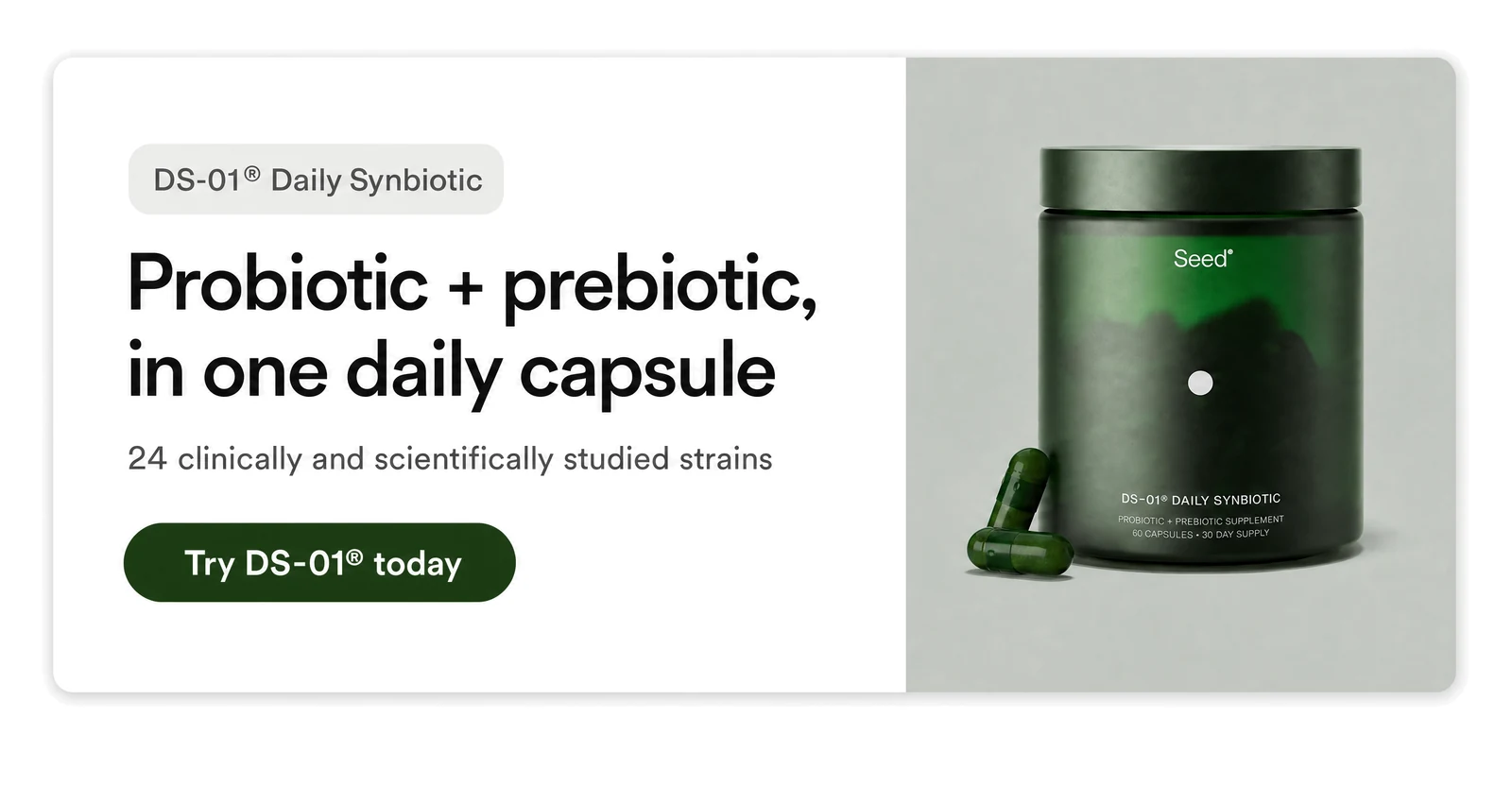
DS-01® is organized into functional blends, each with benefits studied in clinical research:
If you’re used to seeing “CFU” (Colony Forming Units) on labels, you might wonder why Seed uses AFU (Active Fluorescent Units). CFU is the old-school plating method: scientists estimate how many bacteria are viable by counting the colonies that grow on a petri dish.
AFU is considered to be more precise. It uses flow cytometry—lasers that count every single viable cell, including the ones that are alive and active but don’t readily grow on a lab plate.7 That’s how Seed can stand behind the 53.6 billion AFU on the label.
Instead of fermentable fibers like inulin (which can leave some people gassy), DS-01® uses Microbiota-Accessible Polyphenolic Precursors™ (MAPP). Sourced from Indian pomegranate, these non-fermenting polyphenols get transformed by your gut microbes into helpful secondary compounds—like urolithin A, which supports cellular health.8
Your stomach is basically a vat of acid designed to break down food and kill off pathogens, and unprotected biological material has a hard time surviving it. That’s why Seed built the ViaCap®—a capsule inside a capsule. The prebiotics and probiotics work together.
The outer capsule carries the prebiotic pomegranate and shields the inner probiotic capsule from acid, enzymes, and bile salts, so the live microbes actually reach the lower small intestine and colon, where they do their work.
Seed carries its rigor into the packaging. Your first month of DS-01® comes in a refillable glass jar with a glass travel vial. After that, refills arrive in bio-based, compostable pouches, which cuts down on single-use plastic over time.
DS-01® is more than a list of ingredients—the finished formula itself goes through clinical trials. That includes Investigational New Drug (IND)-authorized trials looking at how the complete 24-strain synbiotic affects gastrointestinal function and gut microbiome composition in people.
ARMRA has earned attention for pulling one specific biological product—bovine colostrum—into the center of the wellness conversation.
Bovine colostrum is the very first milk cows produce right after giving birth. Nature makes colostrum intensely nutrient-dense because a newborn calf arrives without a fully built immune system. It delivers a big, temporary handoff of maternal antibodies (IgG), growth factors, and antimicrobial proteins to protect the calf and help seal its “leaky” newborn gut.2
ARMRA takes colostrum from grass-fed cows, strips out the fat and casein (a dairy protein), and cold-extracts it into a powder concentrate. While they do remove casein, this is still fundamentally a dairy-derived animal product—so it’s not suitable for vegans or anyone with a serious dairy allergy.
Instead of plant-based prebiotics, colostrum brings bovine milk oligosaccharides—special sugar chains that can act as food for gut microbes and help keep certain pathogens from latching on. It also contains peptides (short protein fragments that can act as signals) and secretory IgA (the antibody that patrols mucosal surfaces like your gut lining). The logic is passive immunity: you’re swallowing pre-formed animal defense molecules in the hope they’ll line your own digestive tract the way they do for a calf.
According to their website, ARMRA says its proprietary colostrum concentrate strengthens the skin, lung, and gut barriers, supports immune pathways, and can benefit cellular health and performance. They position it as a whole-food foundation for pushing back on the daily environmental stressors that wear down the gut barrier.
ARMRA comes as a loose powder. You pour it straight into your mouth or mix it into cool liquids (hot liquids can degrade the delicate proteins).
But once you swallow, that powder lands in the harsh environment of your stomach. Gastric acid is rough on unprotected biological molecules, including delicate immunoglobulins and peptides.9 ARMRA uses cold-chain extraction to protect the bioactives during manufacturing, but the product offers no physical delivery mechanism—like an enteric-coated capsule—to shield those compounds from digestion once they’re inside you.
The general benefits of bovine colostrum are reasonably well-documented in certain contexts—like sports nutrition and pediatric diarrhea—though more research is still needed.10,11 ARMRA also cites independent clinical trials on its specific concentrate showing positive markers for immune response and gut barrier integrity.12 Still, it leans on an entirely different set of biological interactions than the human-microbe partnership that probiotics target.
Choosing between Seed and ARMRA really comes down to two different philosophies of support.
If you want an active approach for gut health—introducing well-researched, living microbes that interact with your resident bacteria, make helpful metabolites, and support digestion and whole-body health—a clinically studied synbiotic like Seed’s DS-01® is the logical pick. Its ViaCap® delivery also gives you some peace of mind that the delicate ingredients are actually surviving the trip past your stomach acid. And if you’re vegan or strictly dairy-free, DS-01® is really your only option of the two.
If you want a passive approach—pre-made animal antibodies and growth factors acting as a supportive coating for your mucosal barriers—and you’re comfortable with a dairy byproduct in an unprotected powder, colostrum like ARMRA is an interesting food-based alternative.
Supporting your gut barrier and immune health is a goal worth having. But how you get there isn’t a small detail—it’s the whole story.
ARMRA hands your gut pre-formed animal bioactives and asks them to survive a trip through stomach acid with no protection. Seed’s DS-01® takes the precision route: a capsule-in-capsule system that delivers 24 specific living strains plus plant-based prebiotics safely to your colon, where they work with your own biology to support regularity, gut barrier integrity, and healthy immune responses.
🌱 Good gut decisions aren’t made on a hunch. They’re cultured, one daily strain at a time.
Yes, as there are no known contraindications between taking a probiotic and bovine colostrum to date.13
Because they work through completely different mechanisms—live microbial interaction versus passive, pre-formed animal antibodies—you can use them at the same time if you want. Just know that combining them won’t magically merge their effects into something bigger.
No, colostrum is not a probiotic. Probiotics are live microorganisms (bacteria or yeast) that offer a health benefit when you take enough of them.
Colostrum is the first milk mammals produce after giving birth, and it contains no living probiotic bacteria. It works through pre-formed bioactives, proteins, and antibodies instead—molecules that are already made, rather than microbes that go on to do the work once they’re inside you.
If your goal is active digestive support, a synbiotic like DS-01® is built for exactly that.
DS-01® contains living strains clinically studied for digestive endpoints like healthy regularity, better stool hydration, and relief from occasional GI discomfort. In plain terms: it’s designed to help the day-to-day machinery of digestion run more smoothly. Colostrum is generally aimed more at immune support and coating the gut barrier than at driving those everyday digestive processes.
💡 Pro Tip: If regularity and bloating are your main concerns, match the product to the job—look for living strains studied for those specific digestive outcomes rather than a general “gut support” label.



Overview If you’ve ever browsed the probiotic aisle and wondered if you need a science degree just to pick a capsule, you’re definitely not alone. Probiotic ingredient lists can get real technical real fast, and every brand seems to promise to support your gut microbiome in its own unique way. Two of the brands that...

Overview If you’ve ever fallen down a Google rabbit hole or gotten lost in multiple wellness influencer feeds comparing the Just Thrive probiotic vs. Seed, you know it’s not a simple decision. Each brand promises to support your gut, but the differences go way beyond who has more five-star reviews. Instead, you’re faced with unfamiliar...
Overview You’re trying to make a good choice for your health, maybe boost your digestion, or just feel better overall. And on your path to better health, two names you’ve likely encountered are Seed’s DS-01® Daily Synbiotic and AG1. Both promise to support your well-being, but they go about it in quite different ways. It’s...