Next Article
Seed’s DS-01® vs Arrae Tribiotic vs ARMRA Colostrum: Which Gut Support Is Right for You?
9 minutes
Should you choose Seed's 24-strain synbiotic or Arrae's 3-in-1 tribiotic? This guide compares the probiotics, prebiotics, postbiotics, delivery systems, and clinical validation behind Seed DS-01® and Arrae Tribiotic so you can decide which fits your gut health goals.

Choosing between DS-01® Daily Synbiotic and Arrae Tribiotic isn’t as simple as comparing labels. Both are designed to support gut health, but their formulations, delivery technologies, and scientific approaches differ in important ways. And when you’re investing in your gut health, knowing what’s behind the label matters. 🦠
So, what actually sets DS-01® and Arrae Tribiotic apart? From their ingredients to the science behind their formulations, this comparison guide breaks down the key differences, translates the jargon, and helps you make sense of what each product has to offer.
Before the specifics, let’s decode the language. Gut health involves a few supplements that end in “-biotic”:
👉 TL;DR: Seed’s product is a synbiotic, which includes probiotics and prebiotics, and it’s designed to survive the gut’s environment such that postbiotics can be produced in the body. Arrae’s product is a “tribiotic”, which includes probiotics, prebiotics, and a precursor for a specific postbiotic.
| Feature | Seed’s DS-01® Daily Synbiotic | Arrae Tribiotic |
|---|---|---|
| Product Category | Synbiotic (Probiotic + Prebiotic) | Tribiotic (Probiotic + Prebiotic + Postbiotic Precursor) |
| Probiotic Strains | 24 distinct, scientifically studied strains | 8 probiotic strains |
| Live Cell Count | 53.6 Billion AFU | 50 Billion CFU |
| Prebiotics | MAPP™ (Microbiota-Accessible Polyphenolic Precursors from Indian pomegranate) | PreforPro® (bacteriophage blend) |
| Postbiotics | None; produced in the body as gut microbes transform the prebiotic (e.g., urolithins) | CoreBiome® Tributyrin (postbiotic precursor) |
| Delivery Technology | ViaCap® (patented 2-in-1 nested capsule) | Targeted-release vegan capsule |
| Scientific Research Focus | Clinical trials on the final DS-01® formulation | Studies of individual ingredients |
| Price (per 30-day supply) | $49.99 (subscription) | $46.75 (subscription) / $55 (one-time) |
Seed’s DS-01® is built from a “microbe-first” perspective: every element is chosen for a specific, science-backed role in supporting your gut.
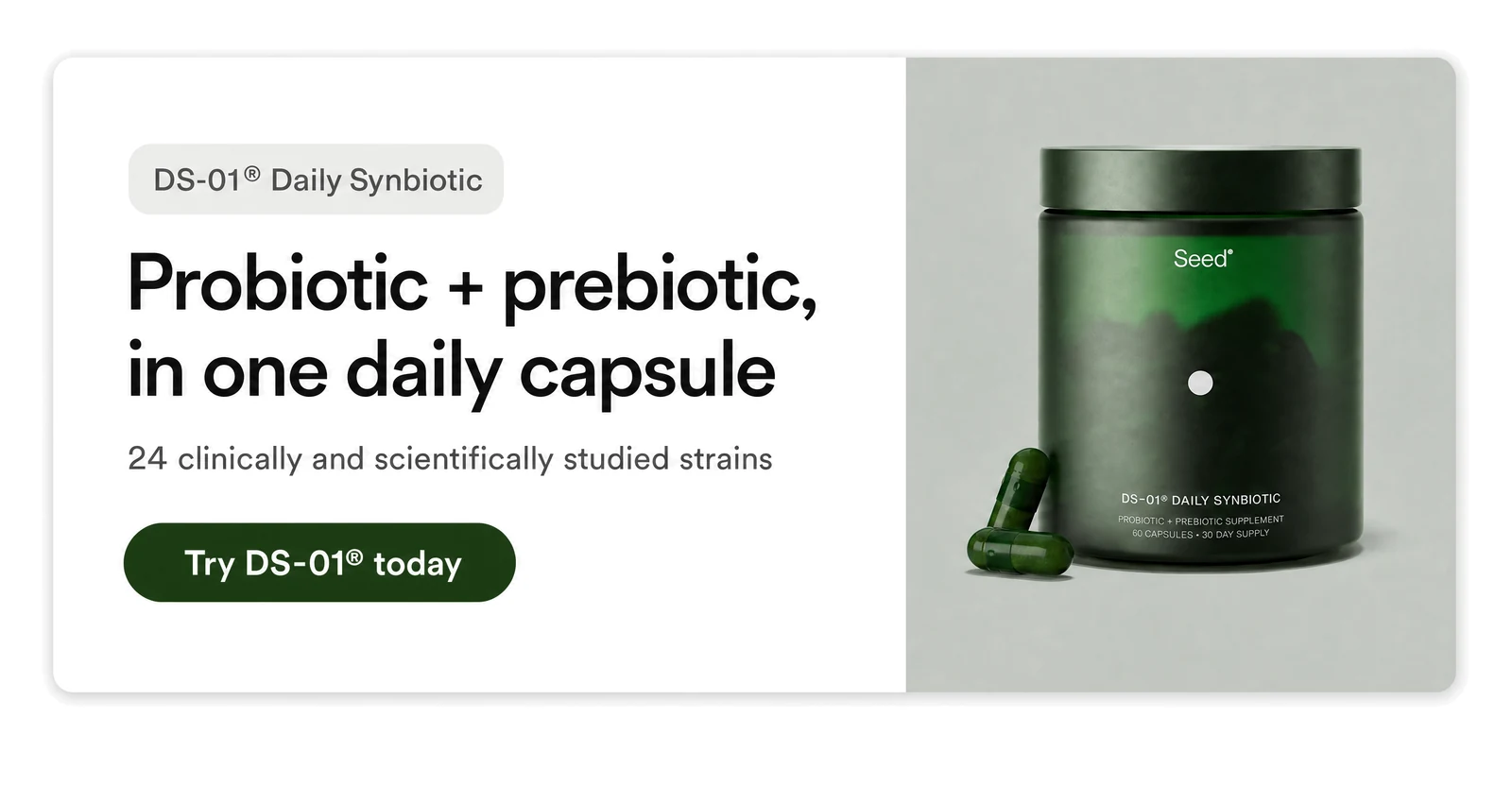
With probiotics, the details matter—and it’s about the specific strain, not just the species. Golden Retrievers and French Bulldogs are the same species (Canis lupus familiaris), but you wouldn’t hire them for the same job. The same is true for bacteria.
DS-01® includes 24 distinct probiotic strains from the Bifidobacteria and Lactobacillus genera, each identified by its full strain designation. That specificity is your assurance you’re getting the exact microbes studied in clinical research—a thoughtfully curated community rather than a random mix.
DS-01® is formulated for daily digestive support, with a few studied secondary benefits.
Based on clinical and mechanistic research, Seed’s synbiotic is formulated to support:
You’ve probably seen big “billion CFU” numbers on probiotic labels. CFU (Colony-Forming Units) is a traditional way to estimate live microbes. Seed uses a more precise technology: AFU (Active Fluorescent Units).
Think of it this way: CFU is like counting the people raising their hands in a crowd—an estimate. AFU, measured by flow cytometry, is like a high-tech headcount that identifies and counts each viable cell, so the dose on the label reflects what’s actually there.6
🤓 Learn more about the difference between AFU and CFU
Instead of traditional fermentable fibers (which can cause gas and bloating for some), DS-01® uses a polyphenol prebiotic—Microbiota-Accessible Polyphenolic Precursors™ (MAPP™)—from Indian pomegranate, a fruit that’s rich in antioxidants and dietary fiber.
These compounds aren’t fermented for energy. Your gut microbes biotransform them into beneficial molecules like urolithins, studied for their effects on cellular health.7 It’s a prebiotic that does more than feed bacteria.
You’ll also notice DS-01® doesn’t add a separate postbiotic. That’s by design: when your gut microbes transform the pomegranate prebiotic, they produce postbiotic compounds in your body rather than delivering a pre-made one. A well-fed microbiome makes its own.
Probiotics are live organisms, and they need protection to survive your stomach’s acid. DS-01® uses the patented ViaCap®, a capsule-in-capsule system.
The outer capsule holds the prebiotic; the inner capsule shields the live probiotics. It’s designed to get past stomach acid and digestive enzymes so the probiotics are released in the lower small intestine and colon, where they work best.
Your first month of DS-01® arrives in a Welcome Kit with a refillable glass jar and a small glass travel vial. Refills come in a compostable, bio-based pouch, cutting single-use plastic. ♻️
Maybe the biggest differentiator is Seed’s commitment to testing the finished product. Seed invests in clinical trials on the final DS-01® formulation—not just its individual ingredients—including IND-authorized clinical trials on the complete synbiotic. That means the product you take is studied as a whole.
Arrae Tribiotic positions itself as a 3-in-1 gut health solution—prebiotics, probiotics, and a postbiotic component—aimed at common digestive complaints like bloating and gas.
Arrae Tribiotic contains eight probiotic strains, including L. acidophilus (La-14) and B. lactis (BL-04), each listed with its strain designation—a mark of transparency. With 50 billion CFU, the formula is focused, though with less strain diversity than DS-01®.
Arrae takes a modern approach to these two components.
Prebiotic (PreforPro®): Instead of a fiber or polyphenol, Arrae uses a blend of bacteriophages—often called “phages,” these are viruses that target specific bacteria, not your own cells. The idea is that phages clear out certain unwanted gut bacteria to make room for the beneficial strains.8
Postbiotic Precursor (CoreBiome® Tributyrin): Tributyrin is a precursor to butyrate, a short-chain fatty acid that fuels the cells lining your colon. Butyrate is beneficial, but tributyrin isn’t a postbiotic by the strict definition (which requires inactivated microbial cells or their components)—it’s a compound that helps your body produce something microbes normally make.
Much of the tributyrin research so far is in lab or animal models, so its benefits in humans aren’t yet clear.9
Arrae focuses on relief for common gut issues—bloating, gas, irregularity—and also markets support for skin, energy, and brain fog. Its marketing also mentions “recolonizing” the gut. ❌ That’s a common misinterpretation of what probiotics do.
In reality, this is wrong, as it goes against the current official understanding that most probiotics are transient: they interact with your microbiome as they pass through, rather than taking up permanent residence.10 That’s why consistent daily intake matters for sustained benefits.
Arrae uses a “targeted-release vegan capsule,” a delayed-release design meant to protect the contents from stomach acid. It’s a widely used, effective method—distinct from Seed’s nested 2-in-1 ViaCap®, which physically separates the prebiotic and probiotic until they reach the gut.
Arrae highlights the clinically studied nature of its individual ingredients, like PreforPro® and CoreBiome®. That’s a common, valid industry approach. It differs from Seed’s strategy of running placebo-controlled clinical trials on the finished DS-01® formulation to validate its safety, tolerability, and outcomes in people.
Both are thoughtfully formulated, but they reflect different philosophies. Here’s the quick version.
Seed’s DS-01® Daily Synbiotic:
Arrae Tribiotic:
Choosing between DS-01® and Arrae Tribiotic comes down to matching a product’s philosophy to your goals. One is a clinically validated daily synbiotic that has been tested as a finished formula; the other is a targeted, innovative blend for specific gut complaints. In a market full of promises, clarity is the rare ingredient.
🌱 Good gut choices aren’t built on hype. They’re cultured with care.
The main difference is composition. DS-01® is a 2-in-1 synbiotic—24 probiotic strains plus a pomegranate-derived prebiotic. Arrae Tribiotic is a 3-in-1—8 probiotic strains, a bacteriophage prebiotic, and tributyrin, a compound that helps your body produce the postbiotic butyrate.
The counts reflect different goals. DS-01® uses a diverse community of 24 strains for daily digestive support with a few studied secondary benefits; Arrae’s 8-strain formula is more narrowly focused on common digestive complaints like bloating and irregularity.
Most probiotic strains don’t. Despite the popular belief, scientific evidence shows they’re transient: they travel through your digestive system, interact with your resident microbes, and are then excreted. That’s why consistent daily intake matters.10
Not necessarily. A sufficient dose matters, but the “best” dose is the one shown effective in clinical studies for a specific strain and benefit. How viable cells are counted matters too—Seed uses AFU (Active Fluorescent Units), a more precise measure than standard CFU, so the label reflects the viable cells actually in the product.


Overview The probiotic aisle can be a lot — bold branding, “super strain” claims, and more “biotics” than anyone can keep straight. If you’ve narrowed it down to Seed’s DS-01® and Ritual Synbiotic+, here’s a straight side-by-side with the science behind each. 🦠 Both are synbiotics built to support your gut microbiome, but they take...

Overview If you’ve ever fallen down a Google rabbit hole or gotten lost in multiple wellness influencer feeds comparing the Just Thrive probiotic vs. Seed, you know it’s not a simple decision. Each brand promises to support your gut, but the differences go way beyond who has more five-star reviews. Instead, you’re faced with unfamiliar...

Overview Gut health is having a moment, and the shelves show it — rows of “biotic” blends all promising a calmer, healthier gut. Two you’ll run into often are Seed’s DS-01® Daily Synbiotic and Klora Gut-Renew. Both say they support your gut, but they’re closer to apples and oranges: one is built around live probiotic...