Next Article
The ‘Leaky Gut Diet’ Demystified: What Does Science Say?
8 minutes
Rosacea doesn’t always respond to creams or careful skincare routines. Researchers are now studying probiotics for rosacea through the gut-skin axis—including what early studies found when probiotics were added after the antibiotic doxycycline, and why the specific strain matters.

You’ve tried switching skincare products and cutting triggers out of your diet (including your favorite snack! 🙁). You’ve even iced your face after a flare-up. And still, the redness and bumps just keep coming back—without warning, without reason. Rosacea is unpredictable, and for many people, the usual fixes just don’t cut it. That’s why some researchers are turning inward—literally—to the gut.
Research on the gut-skin axis suggests your digestive system might be doing more than just breaking down food—it could also be shaping how your skin responds to inflammation.
That’s where probiotics for rosacea enter the conversation. Not as a cure, but as a potential way to support skin health from the inside out.
The evidence is still small, and probiotics have been studied as an add-on to treatment, not a replacement. In the strongest trial, a probiotic taken after the antibiotic doxycycline was linked to lower severity scores than a placebo.1
Rosacea isn’t just about blushing easily or turning red during stressful moments. If you’re dealing with it, you know it’s an ongoing challenge marked by facial redness, persistent flushing, visible blood vessels, and sometimes acne-like bumps or thickened skin.2 On top of the physical discomfort, rosacea can feel frustratingly unpredictable, disrupting daily life and social confidence.
The exact cause of rosacea is still unclear. But researchers agree that it’s an inflammatory condition that can be influenced by several factors.
Some causes include:
Common rosacea triggers can include:
Triggers are highly personal, so your list may not match anyone else’s. (Yes, even your morning latte could make the cut. ☕)
You may not realize it, but your gut and your skin are always chit-chatting. This constant conversation, known as the gut-skin axis, links your digestive health directly to skin health through immune responses, nervous system signals, and inflammatory pathways.3
Your gut is home to trillions of microorganisms—bacteria, viruses, fungi, and archaea—collectively known as the gut microbiota. A balanced and diverse gut microbiota is important for digestion, nutrient absorption, immune system health, and even mood regulation.
When this delicate ecosystem gets disrupted, it can tip into a state called dysbiosis. That can increase gut permeability (often called “leaky gut”) and trigger systemic inflammation.4
Research shows that gut dysbiosis and a weakened gut barrier may allow inflammatory substances and microbial byproducts to enter your bloodstream. This can amplify inflammation elsewhere in the body, including your skin—potentially worsening conditions like rosacea or eczema, which are driven by inflammation.5
A few small studies have found differences in the gut microbiome of some people with rosacea, but they don’t agree on which microbes differ. In 2020, researchers reviewing the evidence found just two gut studies, which included only 23 people with rosacea.6 And it’s unclear if these differences cause flare-ups or follow them.
🔬 Science Translation: When your gut’s microbial community is out of balance, more inflammatory signals may reach your bloodstream—and your skin. Some people with rosacea show gut differences, but scientists don’t yet know which comes first.
In one small study, SIBO (small intestinal bacterial overgrowth) showed up in 52 of 113 people with rosacea (nearly half), versus 3 of 60 without it.7 Clearing it with an antibiotic was followed by clearer skin, unlike placebo—but the doctors rating skin knew who got what.7
H. pylori, a stomach bacterium, has also been proposed as a contributor, but the evidence is mixed.8 Researchers who reviewed 14 studies found only a weak link, and treating it didn’t clearly help.9
No trial has tested probiotics in people with rosacea and SIBO. Gut symptoms are worth raising with your doctor.
Probiotics are live, friendly microbes that can give your gut a boost when taken in the right amounts.10 By helping your gut stay balanced, they might indirectly calm inflammation and support healthier skin, which could be especially helpful for people dealing with rosacea.
Here’s what probiotics might be able to do for rosacea-prone skin:
Some probiotic strains can have conversations with your immune system, helping it stay calm and balanced instead of overreacting.4 Since rosacea is driven by inflammation, that’s a big part of why researchers are curious about probiotics here.
Certain probiotics are being studied because they might help strengthen your gut barrier, keeping inflammatory triggers where they belong—out of circulation.11
In rosacea, the skin’s alarm system is set too high. An enzyme called KLK5 switches on a defense protein, cathelicidin (LL-37), that can drive redness and inflammation.12
In a 2024 trial of a five-strain probiotic taken after doxycycline, the probiotic group had lower blood levels of an inflammation marker (TNF-α) and better skin hydration than the placebo group.1 In mice, probiotics also quieted a related alarm pathway (TLR2/NF-κB).13
🔬 Science Translation: In rosacea, the skin’s inflammation alarm is too sensitive. Probiotics may help turn down some of those signals, but part of this evidence comes from mice, and research in people with rosacea is still small. Promising mechanisms ≠ proven results, so keep your expectations realistic.
So far, probiotics have been studied as an add-on to rosacea treatment, not a replacement for it. Human research is still limited to one small placebo-controlled trial, plus open-label studies and case reports.14,1 And no single strain or approach stands out as best.
In 2024, researchers followed about 60 adults who took doxycycline for two weeks, then a five-strain probiotic, a placebo, or nothing for three months. The probiotic group had lower doctor-rated severity scores than the placebo group.1
A one-month study of E. coli Nissle 1917 reported more improvement in people who took it. But it was open-label (everyone knew who got what), and it mixed rosacea with other rashes.15 And one case report followed a person with scalp rosacea on two strains plus doxycycline.16
In each study, probiotics came after or alongside medical treatment, never in its place.1,15,16 So don’t stop or swap a prescription on your own. If you take antibiotics, check with your doctor or pharmacist about the best probiotic timing for your routine.
More clinical trials are still needed to confirm these potential benefits.14,17
When considering probiotics for rosacea, you’ve got two main players: oral (taken by mouth, usually as one or two capsules per day) and topical (applied directly to your skin).
💊 Oral probiotics target the gut-skin axis, working from the inside out by balancing your gut microbiome to potentially support healthier skin. These probiotics may also support digestive function and immune regulation.
🧴 Topical probiotics work from the outside in, applying beneficial bacteria directly onto your skin to balance the skin microbiome right where symptoms are most visible.18
If you’re considering a probiotic for rosacea-prone skin, here’s what matters:
Not all probiotics play the same position on the field—even when they’re from the same species. That’s because probiotic benefits are strain-specific—meaning only certain strains have been studied and shown to support specific outcomes.19 Same species ≠ same benefits.
When it comes to probiotics, generic labels like Lactobacillus or Bifidobacterium don’t tell you much. What really counts is the strain ID—that string of letters and numbers that follows the species name. That’s where the science lives.
For example, Lactobacillus salivarius LS01 and Bifidobacterium breve BR03 were given with low-dose doxycycline to one person with scalp rosacea, who improved.16 But heads up: one case can’t show what these strains did on their own.
The five-strain trial used Lacticaseibacillus paracasei Zhang, Lactiplantibacillus plantarum P-8, Lacticaseibacillus rhamnosus Probio-M9, and Bifidobacterium animalis subsp. lactis V9 and Probio-M8.1 Since they were tested only together, after doxycycline, no single strain’s effect is known.
💡 Pro Tip: If a product doesn’t list full strain names, it’s impossible to know what you’re actually getting—or if it’s been clinically studied for what you care about.
Those ginormous numbers on probiotic bottles—like “10 billion CFU”—sound impressive, but not all those microbes are necessarily alive or active when you take them.
CFU (Colony Forming Units) is the traditional way of measuring probiotics, only counting microbes that can grow on a petri dish. AFU (Active Fluorescent Units), on the other hand, uses a more advanced method—flow cytometry—to count all viable cells, even ones that are alive but not necessarily culturable.
🦠 Why It Matters: AFU gives a clearer picture of how many living microbes are actually capable of doing something in your body. And whichever method a brand uses, look for a guarantee of that count through the product’s expiration date, not just at the time of manufacturing.
Your stomach is great at breaking things down—and probiotics are no exception. For those beneficial bacteria to have a chance at doing their job, they need to survive the acidic pit stop and actually make it to your colon alive.
Some products use advanced technologies (like capsule-in-capsule systems) to protect probiotics during digestion and time their release further down in your gut.
You may not see skin changes right away. Probiotics work indirectly by supporting gut health, and those effects take time.
Some people notice improved digestion or reduced bloating within a few weeks. If probiotics do affect your skin, that’s further downstream. Rosacea studies ran one to three months and checked skin only at the end, so no trial shows when changes start.15,1
And yes, there may be an initial adjustment period with mild bloating or gas.
Go slow. Stay consistent. Be patient. Probiotics aren’t quick fixes—but they’re in it for the long game.
Probiotics can support skin health—but they work best as part of a broader routine.
For rosacea, a combination of strategies often leads to better results:
Remember: Probiotics can support this kind of approach—but think of them as part of the team, not the entire playbook.
The gut-skin axis offers a science-backed way to understand how your gut health can influence what shows up on your skin. For rosacea—where inflammation and immune overreactions drive much of the story—that connection is worth paying attention to.
Probiotics aren’t a cure for rosacea, but some strains have been studied for their potential to support gut barrier function and help calm inflammatory signaling. If you try one, choose a strain-specific probiotic studied in people, take it consistently, and use it alongside your dermatologist’s care.
🌱 Sometimes, the clearest path to healthier skin doesn’t start in the mirror—it starts in your microbiome.
Not usually. Most well-studied probiotics are safe and well-tolerated.22 Some people may experience mild digestive symptoms like gas or changes in poop habits during the first few weeks. If symptoms persist or skin reactions worsen, check in with your doctor.
There’s no single “best” strain confirmed for rosacea. So far, L. salivarius LS01 and B. breve BR03 were used with doxycycline in one case report.16 A five-strain mix was tested after doxycycline in one small trial, but its strains weren’t tested separately.1
When shopping for probiotics for rosacea, the focus should be on choosing a high-quality product with clinically studied strains known for overall gut health and immune support.
It depends. Digestive changes—like improved regularity or less bloating—may show up within a few weeks. For skin, there’s no tested timeline yet. Rosacea studies ran one month, or three months after two weeks of doxycycline, and checked skin only at the end.15,1
Oral probiotics are better supported by science right now. They act systemically (whole-body) by supporting the gut-skin axis.3,1 Topical probiotics may one day play a role, but for rosacea, the evidence is still early-stage.18



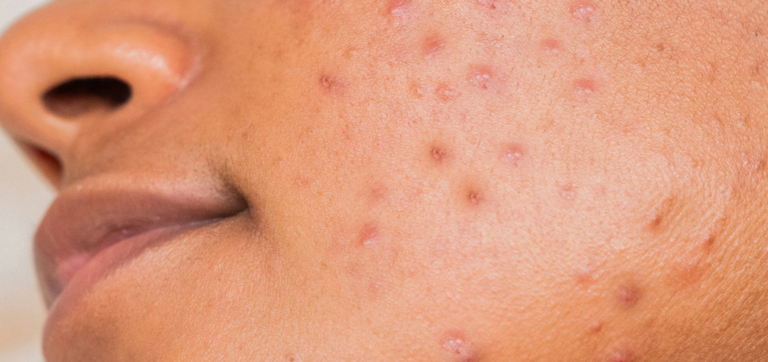
Breakouts aren't just skin deep. Discover how gut health, the gut-skin axis, and strain-specific probiotics may influence acne—and why clearer skin could start in your microbiome.

Taking probiotics but not sure if they're working? These "good bacteria" get straight to work. But while some changes appear in days, others take weeks or months. Here's what science tells us about how long it takes for the effects of probiotics to kick in.

This guide identifies the best probiotic strains for women's health concerns from vaginal microbiome balance to digestive comfort. Learn about L. crispatus for vaginal health, strain-specific benefits for women over 50, and how to evaluate quality beyond marketing claims.