Next Article
Fermented, Brined, or Just Vinegar: Which Pickles Actually Support Your Gut
8 minutes
Green tea is often praised as a gut health superstar, but the research tells a more nuanced story. EGCG and polyphenols do real things in your digestive system, though the evidence is stronger in some places than others.

The kettle clicks off and you pour the second cup of the morning, the one you started drinking for your gut rather than the caffeine. Somewhere in the back of your mind is a half-remembered headline about polyphenols.
That headline was probably accurate. Green tea’s polyphenols do reach your colon, and your gut bacteria do break them down into compounds that appear to matter. Most of what’s known about where that leads, though, comes from mice. And mice are not you. 😬
So, is green tea good for gut health? The honest answer has three parts: what the lab work shows, what human trials haven’t replicated, and what to do with your cup either way.
All true teas (green, black, white, oolong) come from the same plant, Camellia sinensis. What separates them is processing. Green tea leaves get steamed or pan-fried soon after harvest, which stops them from oxidizing and keeps more of their catechins intact.1
Catechins are plant compounds that neutralize reactive molecules before those molecules can damage cells, which is what “antioxidant” means in practice. The most studied one in green tea is epigallocatechin gallate, or EGCG, and it belongs to the broader polyphenol family found across plant foods.2
The reason polyphenols matter for gut health specifically is where they end up. They aren’t fully absorbed in your upper digestive tract, so a substantial portion reaches the colon, where your gut microbes break them down.3
🔬 Science Translation: Most of what you swallow gets absorbed long before the colon. Green tea polyphenols are different. They’re more like a package addressed to a downstairs neighbor: they pass the floors above without being opened, and the microbes at the bottom are the ones who unwrap them.
The relationship runs both ways. Your gut bacteria break polyphenols into smaller, active metabolites, and those same polyphenols influence which bacteria do well in your gut.4
Feed mice green tea polyphenols and two things tend to follow: more Lactobacillus and Bifidobacterium, and higher production of short-chain fatty acids, the compounds that feed the cells lining your intestinal wall.5 Animal work also suggests EGCG may support gut barrier integrity, the system that keeps unwanted substances out of your bloodstream.6
In one mouse study, green tea given ahead of a high-fat diet altered the gut microbiome and was linked to less weight gain than that diet usually produces.7 Another found that green tea extract reduced markers of gut inflammation and intestinal permeability in mice on the same kind of diet.8
Promising signals, all of them. Also all in animals. 😅
Human trials have been less tidy. In a randomized, placebo-controlled trial, healthy adults took green tea supplements for 12 weeks and their gut microbiome composition didn’t measurably change.9 That doesn’t rule out effects at a functional level, but it does mean the dramatic microbial shifts seen in mice don’t automatically show up in people.
A cohort study of more than 2,000 older adults found that habitual green tea drinking, three or more cups a day, was associated with differences in microbiome diversity, but only among men.10 Individual responses may depend on sex, baseline diet, existing health status, and the microbial makeup you start with.
Dirk Gevers, Ph.D., Chief Scientific Officer at Seed Health, describes the translational challenge plainly. “The gap between what we observe in a controlled laboratory model and what happens in the complexity of the human gut is one of the most important conversations in microbiome science right now. It doesn’t diminish the potential. It means we need to be precise about what the evidence supports and where the science is still developing.”
Part of that gap comes down to biology, not just study design. Lab mice are typically genetically similar, raised in controlled environments, and fed standardized diets, making it easier to detect a polyphenol’s effect against a stable microbial backdrop. People are the opposite: variable diets, lifestyles, and gut microbiomes mean the same green tea polyphenols get metabolized differently from person to person, since it’s gut bacteria that break them down into their more bioactive forms in the first place.4
If someone’s gut doesn’t happen to host the bacteria needed to convert EGCG into its more active metabolites, a study might not pick up the same signal researchers see in a genetically uniform mouse colony, even if the compound is doing something at a smaller, individual level.
👉 TL;DR: Green tea polyphenols have a plausible mechanism and encouraging animal data behind them. What they don’t have yet is human trials showing the same effects at the same scale.
If you already enjoy green tea, a few practical things are worth knowing.
Probiotics work through a different mechanism entirely: they’re live microorganisms that, when taken in adequate amounts, can confer a health benefit on the host.15 Where green tea’s polyphenols may nudge the microbial environment as they’re broken down, a probiotic delivers live probiotic strains.
Neither substitutes for the other, and the polyphenol connection doesn’t end with your mug. DS-01® Daily Synbiotic’s prebiotic, MAPP™ (Microbiota-Accessible Polyphenolic Precursors), is a polyphenol too. It’s just sourced from punicalagins in Indian pomegranate rather than tea leaves, and it’s paired with live bacteria strains rather than left to act alone.
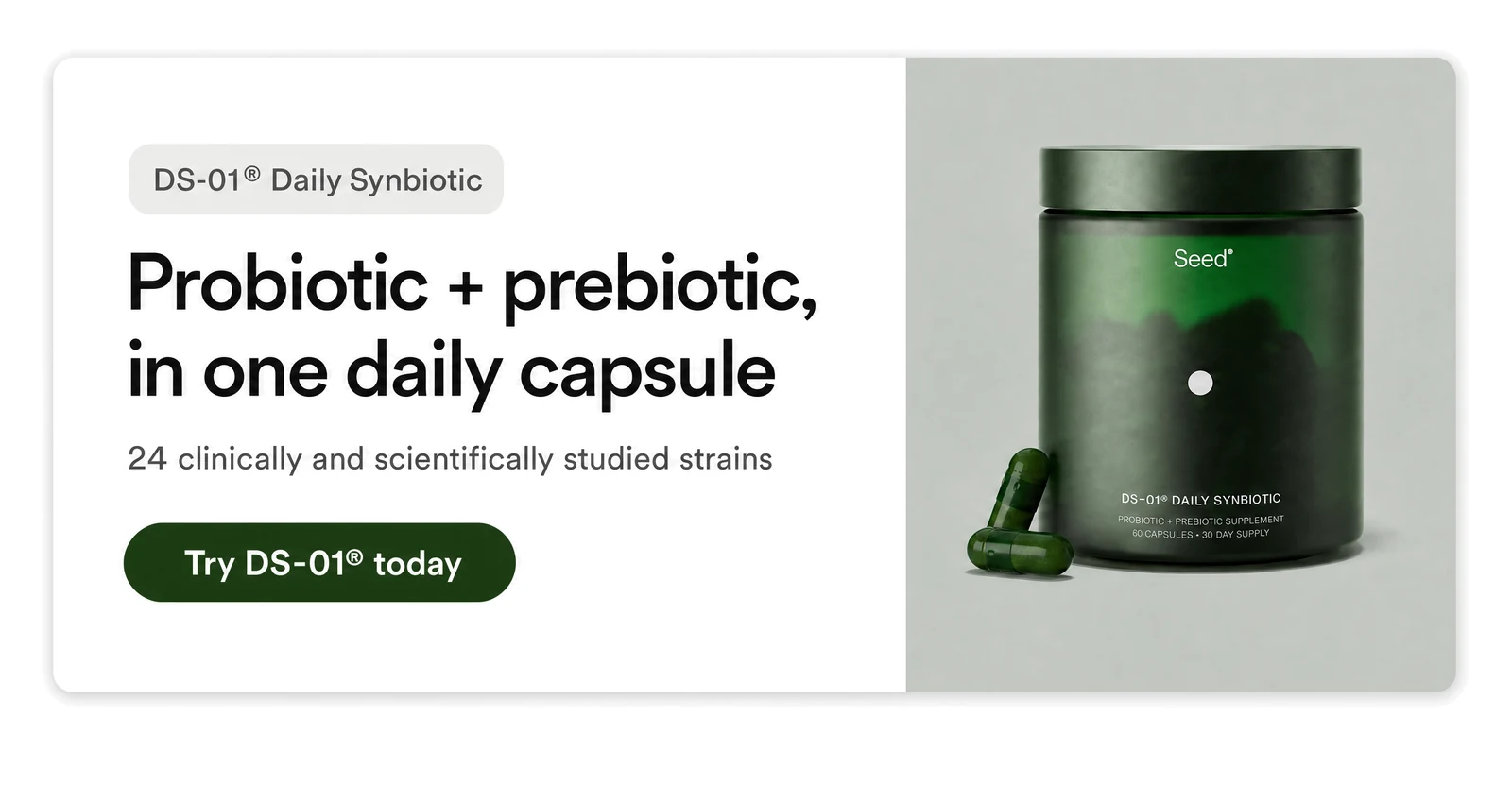
Green tea and a synbiotic like DS-01® aren’t solving the same problem: one is a plant compound your existing microbes may use, the other adds live bacteria to the mix.
Twelve weeks of green tea didn’t measurably change which bacteria live in your gut. But that’s not actually what the lab research was measuring. The animal studies point to something more specific: not which microbes are there, but what your existing microbes do with the polyphenols once they arrive. That’s a different question, and a different measurement.
It’s a bit like weighing yourself to find out whether you slept well. The number is real. It just isn’t answering the question you asked.
That reframes what to expect from your cup. Green tea isn’t recruiting new bacteria to your gut. It’s handing the bacteria you already have something to work with. What they do with it depends on which microbes you started with, which is likely part of why the same three cups a day looked different in men and women.
🌱 Green tea won’t plant new bacteria in your gut, but it gives the ones already there something to grow on.
Possibly, but the human evidence is limited. Green tea polyphenols reach the colon and get metabolized by gut bacteria, which is a plausible route to benefit.1 But a 12-week randomized trial found no measurable change in gut microbiome composition in healthy adults.9 Animal studies look more encouraging than human ones, so green tea is reasonable to include in a gut-friendly routine without treating it as the main event.
Green tea, based on how much of it has been studied. Its catechin content, especially EGCG, has drawn more research attention than other teas.1 Different teas carry different active compounds, so “best” depends on what you’re after. If gut microbiome support is the goal, green tea is a sensible place to start, with the caveat that more human research is still needed.
No established target. Consistency matters more than volume. The cohort research that found microbiome differences looked at habitual drinkers having three or more cups daily.10 Green tea also contains caffeine, so factor it into your overall intake. If you’re sensitive to caffeine or prone to digestive discomfort, start with a smaller amount and see how your body responds.
Yes, for some people, especially on an empty stomach. Tannins and caffeine can cause nausea, stomach discomfort, or acid reflux, particularly in larger amounts. Tannins also bind iron and reduce how much of it you absorb.12 Drinking tea with food and cutting back usually helps. If digestive symptoms are ongoing, it’s worth checking in with your healthcare provider.
Not exactly, but it may have a prebiotic-like effect. ISAPP defines a prebiotic as a substrate that host microorganisms selectively use to produce a health benefit.16 Green tea polyphenols do reach the colon, where gut bacteria metabolize them, and they may encourage the growth of certain beneficial species.5 To earn the prebiotic label for human benefit, though, that benefit would need confirmation in people, and that evidence is still developing.


Strategies for supporting digestive health beyond diet—from regulating your sleep timing to exploring your local park.

You've started taking probiotics, and now you're wondering: "Are they actually doing anything?"
Overview You know that feeling when someone’s talking to you, but their words just… float past? When you read the same email three times and still don’t process it? That might be a sign that your brain is “running on fumes.” 🧠 In times of exhaustion, many of us reach for coffee. And sure, caffeine...