Next Article
Probiotics for Bad Breath: Science-Backed Solution or Oral Health Hype?
9 minutes
Breakouts, mood swings, digestive chaos—can the best probiotics for teenagers help? Research hasn't crowned one winner for healthy teens. Here's what the research actually tested, why the exact formulation and dose matter, and how to check a probiotic's fit with your teen's pediatric clinician.

If being a teenager feels like a whirlwind, it’s because, scientifically, it kind of is. Growth spurts, brand-new independence, and a body that suddenly feels like it’s switched operating systems overnight—it’s a lot. Add to that a social life that shifts, school stress that’s not exactly gentle, and snack choices that sometimes seem…questionable (pizza again?). And through it all, your teen’s gut microbiome is adapting right alongside them, quietly influencing how they feel, function, and even show up in the world.
So, could probiotics—the so-called “good bacteria”—make a difference for your teen? Maybe for a specific need, but there isn’t a research-backed winner for healthy teenagers. Studies so far have tested particular probiotics for particular needs, not everyday wellness in healthy teens. Results also depend on the exact formulation tested.
What you can do is read the science with clear eyes—and know when to loop in your teen’s pediatric clinician. 🤝
Adolescent bodies are in full-on transformation mode: bones lengthening, hormones recalibrating, and stress levels peaking (usually right before finals). And while all this drama shows up on the outside, your teen’s gut microbiome—think: trillions of bacteria, fungi, and other microbes—is feeling it, too.
Remember your own teenage years? The mood swings, the sleep deprivation, the late-night drive-thru trips? Every one of those is linked to shifts in the gut. Here’s how:
All these changes can make teen microbiomes less stable and diverse—so it’s a time when extra support can really matter.
Gut health covers a lot more than keeping things predictable in the bathroom. Your teen’s gut microbiome acts like mission control, sending signals that can impact skin, mood, and immunity.
Supporting the gut can mean helping your teen with much more than digestion, even when life feels out of control. 💪
Research has tested particular probiotics in teens with specific health concerns. It hasn’t found one best option for otherwise healthy adolescents. (Sorry, “best of” lists.)
Lacticaseibacillus rhamnosus GG is a front-runner here. This strain is supported by multiple clinical studies for helping maintain digestive regularity in kids and teens.8,9 And while it’s not about eliminating every off day, it does give the gut an assist against disruptions. Meanwhile, Bifidobacterium longum CECT 7347 shows promise for supporting the gut barrier—think of it as backup for the lining that helps keep the system balanced.10
Persistent pain or major bowel changes belong with a pediatric clinician.
🔬 Science Translation: So far, no probiotic has been shown to help every healthy teen’s occasional stomach trouble.
Teen skin can be a wild card—clear one week, breakout city the next. The gut-skin axis is real, but that doesn’t make every probiotic a skin product.
Research suggests teens’ gut microbiota can look different depending on how their skin is doing.11 Research points to strains like Bifidobacterium lactis CECT8145 and Bifidobacterium longum CECT7347 as possible allies, particularly in supporting skin barrier function.12 No probiotic can promise clearer skin for every teenager.
The gut and immune system work closely together. Certain strains have been shown to help the body respond to seasonal immune challenges and support respiratory tract health. Examples include Lactobacillus acidophilus NCFM and Bifidobacterium lactis Bi07, as well as the combination of Ligilactobacillus salivarius LS01 and Bifidobacterium breve B632.13,14
And don’t count out L. rhamnosus GG—its benefits extend beyond digestion, with research showing a role in supporting upper respiratory function, too.15
Look for evidence on the exact formulation in a matching age group and outcome. Vaccines, sleep, nutrition, and medical care still do the heavy lifting.
The gut-brain axis helps the gut and brain communicate. New research shows that the gut microbiome can influence everything from stress response to emotional regulation.6 “Psychobiotics”—probiotic strains studied for their potential to support mental well-being—are an emerging area, so it’s not clear which strains are best, but the early results are promising.16
A probiotic isn’t a mood treatment. Mental-health concerns deserve care from a qualified professional.
A pink, blue, or “teen” label doesn’t show that a product works for that group. (Your teen’s gut bacteria couldn’t care less about the color of the bottle.) Evidence > packaging.
Check the exact formulation, dose, population, and outcome. Lifestyle, medications (like antibiotics), health history, and individual response also matter.
Think of probiotic formulations as specialists. A preparation studied for one job can’t automatically take on every other assignment.
As Dirk Gevers, Ph.D., Seed’s Chief Scientific Officer, explains: “Each probiotic strain has its own specialized role. The results you get depend on the type you take, how consistent you are, and how long you take them. One strain might support digestive regularity, while another is studied for immune support. This level of precision is important to seeing reliable outcomes.”
👉 TL;DR: Skip the buzzwords and mystery blends. Look for evidence that matches your teen’s age, need, and health context.
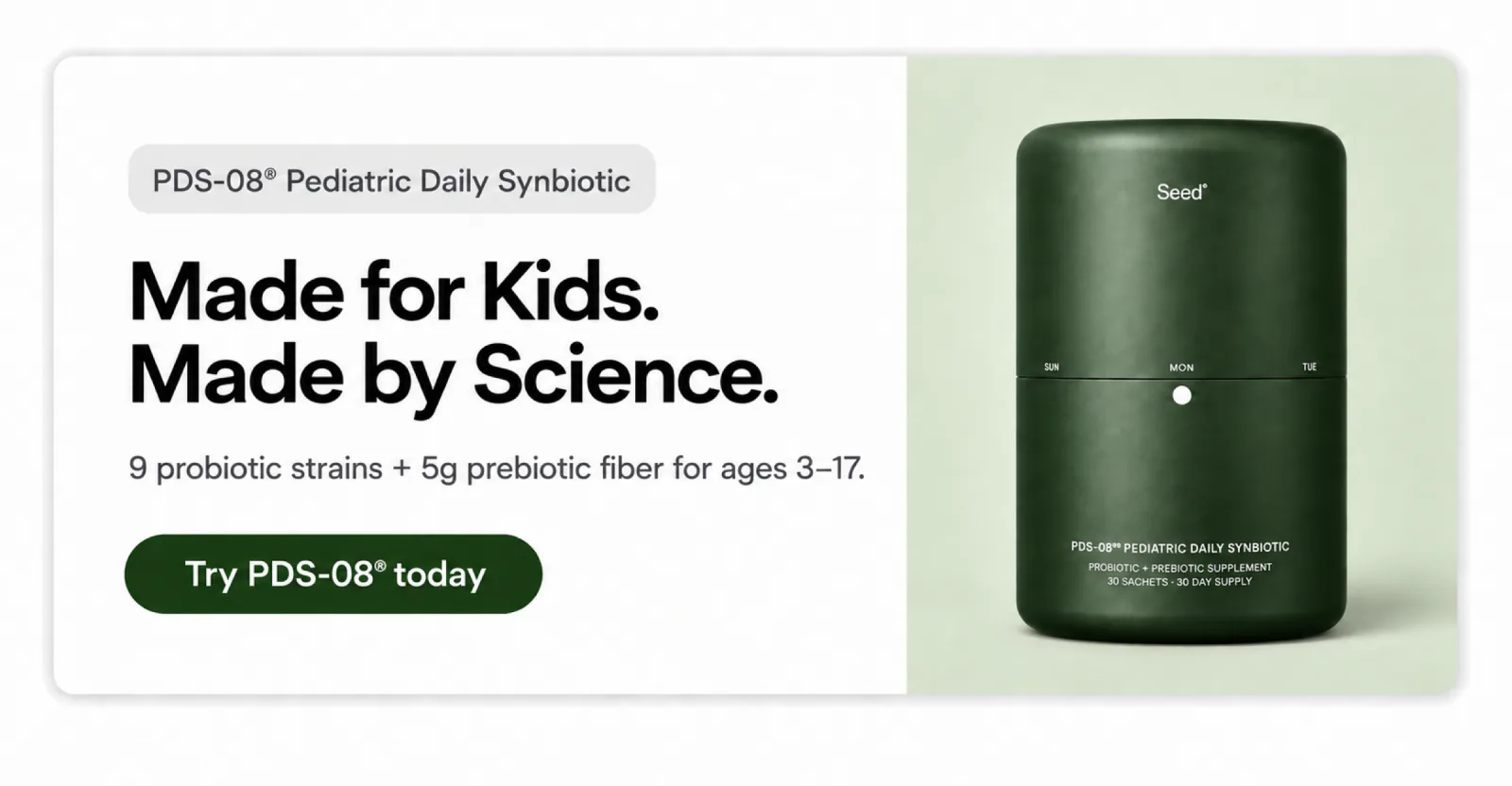
PDS-08® Pediatric Daily Synbiotic is a clinically studied 2-in-1 powdered synbiotic, formulated for children and adolescents ages 3-17 with 9 probiotic strains and a fiber-based prebiotic. It’s formulated for benefits in and beyond the gut.º It’s engineered to survive digestion, with 5g of prebiotic fiber per serving and no refrigeration necessary.
There is no research-backed “best probiotic” for otherwise healthy teenagers. The strongest teen evidence comes from exact formulations studied for specific concerns.
So ask sharper questions before you buy: Was this formulation tested in adolescents, for the same concern, at the same dose? And does your teen’s pediatric clinician think it fits their health history?
🌱 Gut health during adolescence is bigger than one capsule. Food variety, fiber, sleep, movement, stress support, and appropriate medical care still set the foundation.
Symptoms alone can’t tell you that a teen needs a probiotic. Ongoing stomach discomfort, changes in bowel habits, or symptoms that disrupt daily life should be checked by a pediatric clinician.
Many healthy teens tolerate some probiotics, but daily use isn’t right for every teen or product. Ask a clinician first if your teen is immunocompromised, has a medical condition, takes medication, or has persistent symptoms.
Gut health and skin health are connected, and certain probiotic strains have been studied for their role in skin health. Evidence is growing that gut health may play a role in how skin looks.5
There isn’t one timeline for “teen probiotics.” Timing depends on the formulation, the outcome, and the dose. Decide which signs of progress you’re tracking. Then ask a clinician how long to stick with it before you reassess.
º These statements have not been evaluated by the Food and Drug Administration. This product is not intended to diagnose, treat, cure, or prevent any disease.



Overview We’ve all had those off days—your stomach feels unsettled, your energy’s tanking, or you’re uncharacteristically irritable. It might not be your first thought, but what if these frustrations were your gut trying to send an SOS? Your digestive system is home to trillions of microbes, all busily contributing to digestion, immunity, and even your...

Overview Whether you’re chasing a personal best, showing up for weekly pickup games, or simply making movement a steady part of your routine, you know how many factors can shape a good training day—or throw it off track. But there’s one system that flies under the radar: your gut microbiome. 🦠 It may not come...

Overview So, you’re pregnant! (Congratulations 🎉) If you’re like most parents-to-be, you’re swimming in advice—from the earnest advice you got from your OB-GYN to the well-meaning but slightly wild that comes from your relatives and 2 a.m. Google deep-dives. When every choice feels monumental, even something like “probiotics for pregnant women” can sound like a...