Next Article
Gut Health for Women: How Your Microbiome Shifts at Every Life Stage
5 minutes
Dive into a detailed comparison of Seed's DS-01® Daily Synbiotic and The Nue Co. Pre + Probiotic. We break down strains, potency (AFU vs. CFU), prebiotics, delivery tech, scientific backing, and price to help you choose the right gut health support. Make an informed decision based on science.
If you’ve browsed the wellness aisle lately (or your social feed), you’ve probably seen probiotics and prebiotics making big promises for gut health. But when you’re choosing a synbiotic—a combination of both—the science matters as much as the label. Two that might catch your eye are Seed’s DS-01® Daily Synbiotic and The Nue Co. Pre + Probiotic. Both are marketed for gut support, but their formulations, delivery systems, and scientific validation differ significantly. 💡
Choosing the right synbiotic isn’t about the flashiest claims—it’s about what’s inside, how it works, and whether the science supports it. Let’s unpack exactly what sets these two apart.
Both products are synbiotics, meaning they contain probiotics (live microorganisms) and prebiotics (compounds that selectively feed beneficial microbes). The prebiotic is meant to help either the included probiotic strains or your native gut bacteria thrive.1
That said, the type of probiotics and prebiotics, the number of strains, and the depth of research behind them can vary—a lot.
| Feature | Seed’s DS-01® Daily Synbiotic | The Nue Co. Pre + Probiotic |
|---|---|---|
| Product Category | Dual-strain, multi-species synbiotic | Single-strain (spore-based) synbiotic |
| Probiotic Strains | 24 distinct, clinically-researched strains from Lactobacillus and Bifidobacterium genera | 1 strain: Bacillus coagulans MTCC 5856 (LactoSpore®) |
| Live Cell Count | 53.6 Billion AFU | 15 Billion CFU (spores) |
| Live Cell Count Measurement | AFU (Active Fluorescent Units) | CFU (Colony Forming Units) |
| Key Benefit Claims | Digestive health (regularity, bloating), gut barrier integrity, gut immune function, cardiovascular health, dermatological health, micronutrient synthesis | Gut health, eases bloating, supports immunity, skin, mood, and sleep |
| Prebiotic Type | MAPP™ (Indian Pomegranate extract – punicalagins, non-fermenting polyphenolic) | Organic Inulin (from Jerusalem artichoke root – fermentable fiber) |
| Postbiotic Component | None | None |
| Delivery Technology | ViaCap® (2-in-1 nested capsule, targeted release) | Delayed-release capsule |
| Scientific Research Focus | Strain-specific human clinical trials, mechanistic research, ongoing trials on finished product | Relies on existing research for the specific B. coagulans strain (LactoSpore®) |
| Sustainability | Refill system, compostable/recyclable packaging, glass components, biomaterials | Jar (glass), offers refills to reduce packaging |
| Price (per 30-day supply) | $49.99 (subscription) | $55 (one-time purchase), $44 (subscription) |
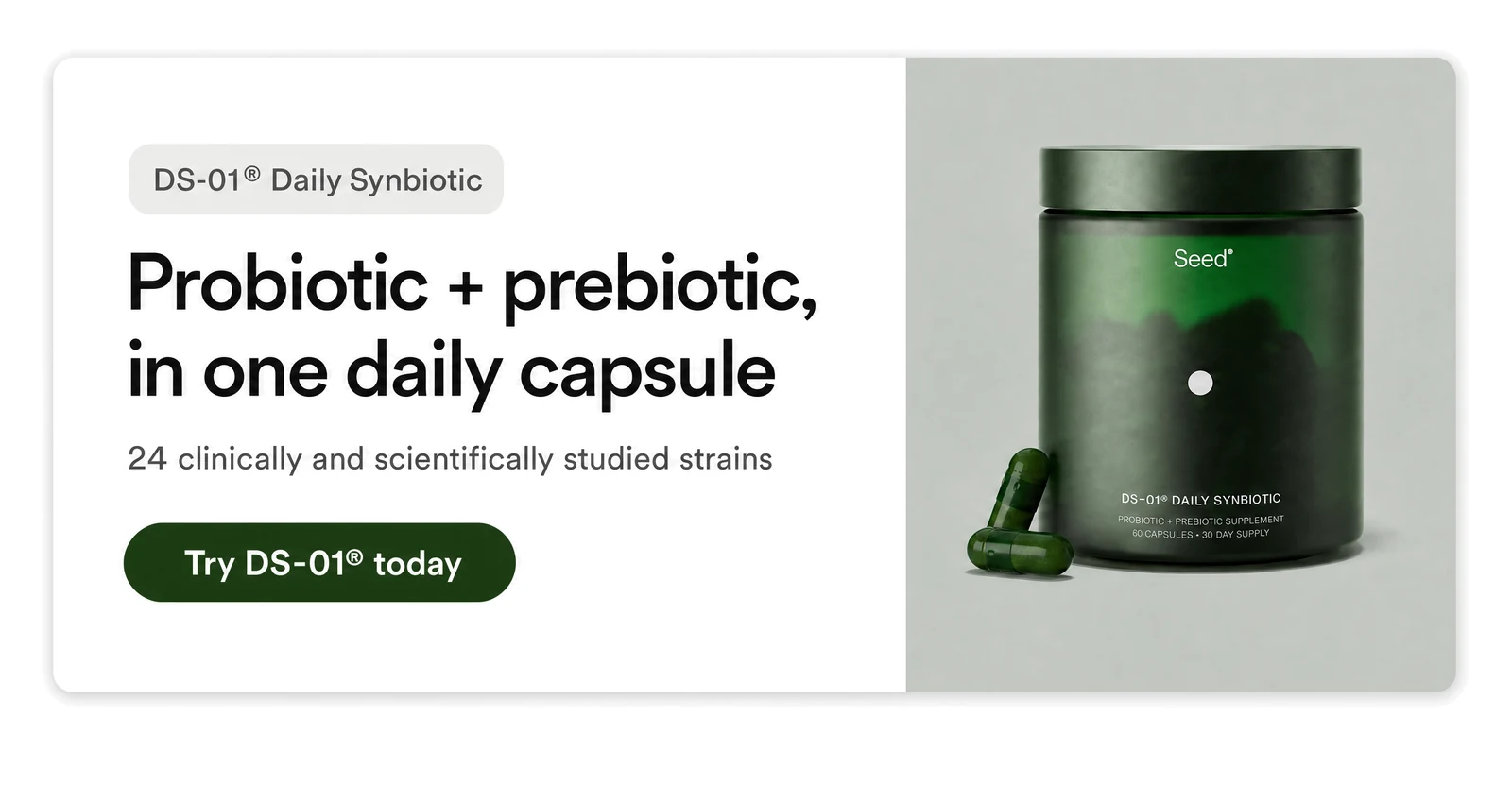
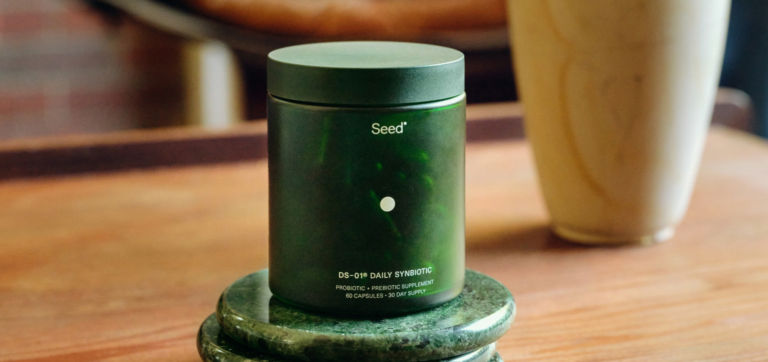
Seed’s DS-01® Daily Synbiotic is designed with a systems-based philosophy—supporting not just digestive comfort, but also skin health, heart health, and nutrient production. It brings together 24 clinically and scientifically studied probiotic strains and a novel polyphenolic prebiotic, all delivered with precision in mind. Microbiome scientist Dirk Gevers, Ph.D., explains, “The term ‘probiotic’ is incredibly broad. A probiotic’s benefits are strain-specific, not species-specific, and certainly not universal to all probiotics. One strain might support digestive regularity, while another is studied for immune modulation.”
Rather than focusing on a single organism, DS-01® draws from both Lactobacillus and Bifidobacterium genera, pairing species and strains with documented, strain-specific benefits. This includes well-studied strains like L. plantarum LP01, B. breve BR03, and B. longum BB536, which have been researched for easing occasional bloating, promoting healthy regularity, and supporting overall gut comfort.2,3
Other strains in the formulation have been investigated for their roles in maintaining gut barrier integrity, modulating immune responses, and contributing to micronutrient synthesis. This multi-strain design is meant to work like a team—addressing different ecological “jobs” in the gut microbiome to support both local and systemic functions.
While many probiotic labels list CFU (Colony Forming Units), DS-01® instead uses AFU (Active Fluorescent Units), measured by flow cytometry. The difference is more than technical—AFU counts all viable cells, including those that are alive and active but may not grow on a standard lab plate, offering a more complete picture of potency.4
DS-01® delivers 53.6 billion AFU per daily serving, aligning dosage with strain-specific clinical research and ensuring that the live microbes you take are measured in the same way they are studied.
The prebiotic in DS-01® is not your average fermentable fiber. MAPP™—Microbiota-Accessible Polyphenolic Precursors—comes from Indian pomegranate and is a non-fermenting polyphenolic extract. Rather than being “food” for bacteria in the traditional sense, MAPP™ is biotransformed by specific gut microbes into metabolites like ellagic acid and urolithins, which have been associated with benefits for skin health, gut function, and microbial balance along the gut-skin axis.5 This means you can gain targeted metabolite production without the excess gas sometimes linked to fermentable fibers.
To help these strains survive their trip through the stomach’s acidic environment, DS-01® uses ViaCap®, a nested capsule system.
The outer capsule houses the prebiotic and shields the inner capsule from heat, moisture, and oxygen.
The inner capsule contains the probiotics, engineered for delayed, targeted release in the colon—where they can interact with your gut ecosystem most effectively. This delivery system has been validated using SHIME®, an advanced simulator of the human digestive process, to confirm survivability.
Seed’s product design extends beyond the capsule. Your first month comes in a refillable glass jar with a travel vial, while refills arrive in compostable bio-based pouches. Packaging is either recyclable, compostable, or both, aligning the product’s environmental footprint with the brand’s science-driven ethos.
The Nue Co.’s Pre + Probiotic takes a more streamlined approach. It contains a single probiotic strain, Bacillus coagulans MTCC 5856 (LactoSpore®)—a spore-former known for its natural resilience to heat and stomach acid. This resilience allows the spores to remain dormant until they reach the small intestine, where they become metabolically active. Each two-capsule serving provides 15 billion CFU (spores).
The prebiotic component is inulin from Jerusalem artichoke, a fermentable fiber that can feed beneficial bacteria but may also cause digestive discomfort, such as gas or bloating, in people sensitive to FODMAPs.6 Delivery is through a delayed-release capsule, which adds an extra layer of protection for the spores during digestion.
Scientific support for B. coagulans MTCC 5856 includes research on digestive comfort and certain IBS-related outcomes.7,8 However, the majority of studies are on the strain itself rather than the finished product, meaning its claimed benefits may not account for how the final formulation interacts as a whole.
If your priority is multi-strain, broad-spectrum support, DS-01® stands out. It pairs strain diversity with AFU measurement, a non-fermenting prebiotic, and tested delivery technology.
The primary differences lie in their composition, prebiotics, and scientific approach.
Seed’s DS-01® has 24 strains of Lactobacillus and Bifidobacterium with a non-fermenting polyphenolic prebiotic and strain-specific research.
The Nue Co. Pre + Probiotic uses a single spore-forming strain (Bacillus coagulans) with inulin, a fermentable fiber prebiotic, and uses existing research for this strain.
Seed’s DS-01® offers more diversity with 24 strains chosen for a range of potential benefits.
The Nue Co. focuses on one robust, spore-forming strain, B. coagulans, which has its own set of researched benefits, primarily related to digestive comfort and resilience.
Seed DS-01® uses AFU, which counts all viable cells, including those that may be active but not culturable by traditional CFU. Nue Co. uses CFU, a long-standing industry standard for measuring live, culturable bacteria.



You've started taking probiotics, and now you're wondering: "Are they actually doing anything?"
Overview We’ve all had those off days—your stomach feels unsettled, your energy’s tanking, or you’re uncharacteristically irritable. It might not be your first thought, but what if these frustrations were your gut trying to send an SOS? Your digestive system is home to trillions of microbes, all busily contributing to digestion, immunity, and even your...
Overview Living with Polycystic Ovary Syndrome (PCOS) can feel like a never-ending balancing act. Hormones acting up, your metabolism in flux, and let’s be honest—a ton of advice that’s equal parts hopeful and confusing. You’ve probably heard it all: Change your diet, exercise regularly, practice mindfulness. But here’s a twist you might not expect: your...