Next Article
Cottage Cheese and Gut Health: Separating Real Benefits From Probiotic Claims
8 minutes
Women's gut health is shaped by hormonal changes from puberty through menopause. Learn about the estrobolome, life-stage microbiome shifts, and evidence-based strategies, from dietary diversity to clinically studied probiotics, that can support your gut at every age.

If your digestion seems to have a personality of its own (fine one week, completely unpredictable the next), you’re not imagining things. For many women, gut health shifts with hormonal changes in ways that feel random but actually follow a pattern.
Your gut and your hormones stay in constant conversation. 😅 The microbiome (the trillions of microorganisms in your digestive tract) responds to shifts in estrogen and progesterone throughout your life. That’s why digestion can feel different during your period, pregnancy, or menopause.
Your gut bacteria don’t just react to those hormones. They actively participate in metabolizing them, a two-way relationship that changes how you think about supporting your health at every stage of life.
You’ve probably heard the basics: eat fiber, manage stress, get enough sleep. All good advice. But women’s gut microbiomes are fundamentally different from men’s, and that difference becomes apparent after puberty.1
The reason comes down to hormones. Estrogen and progesterone don’t just influence your reproductive system. They also shape which bacteria thrive in your gut, how quickly food moves through your digestive tract, and how your gut barrier functions.2
One clear example is the estrobolome: a collection of gut bacteria that produce an enzyme called beta-glucuronidase, which helps metabolize and recirculate estrogen in your body.3 (Despite the name, it’s not a sci-fi villain, just a hardworking group of microbes doing chemistry.)
When your gut microbiome is diverse and well-supported, this process tends to run smoothly. When it’s disrupted (by diet, stress, or antibiotics), estrogen metabolism can go off track. 4
Your gut isn’t just digesting food. It’s participating in hormonal regulation that affects everything from your mood to your menstrual cycle.
🔬 Science Translation: You can think of the estrobolome like a recycling center for estrogen. When it’s running well, hormones get processed and reused efficiently. When the system gets backed up, that recycling process stalls, and estrogen levels can drift off balance.
If you’ve noticed bloating before your period or looser stools when it arrives, your gut is responding to hormonal shifts in real time. During the luteal phase (the second half of your cycle), rising progesterone slows gut motility. That means food moves more slowly through your digestive tract, which is why bloating and occasional constipation tend to show up before your period.5
When menstruation begins and progesterone drops, prostaglandins kick in to help your uterus contract. Those same compounds also affect your intestines, which is why occasional diarrhea during your period is a real (and perfectly normal, if annoying) thing.
Pregnancy brings dramatic hormonal shifts, and your gut feels every one. Elevated progesterone slows digestion further, making occasional constipation one of the most common complaints during pregnancy.
Meanwhile, the gut microbiome itself changes composition across trimesters, a shift researchers believe may support nutrient absorption and immune adaptation for both the pregnant person and baby.1 These changes appear to be hormonally driven, which means they’re a feature of pregnancy biology, not a sign that something is wrong.
As estrogen levels decline during perimenopause and menopause, your gut microbiome shifts too, which may explain new digestive symptoms that show up around this transition. Research shows gut bacteria composition changes at the genus level after menopause, though scientists note more high-quality studies are still needed to fully map these patterns.6
There’s an encouraging finding alongside these shifts: a review of clinical trials found that probiotic interventions may support women through the menopause transition, with reported benefits for menopausal symptoms, psychological health, and urogenital health.7 It’s still a growing area of research, but a promising one.
“The gut microbiome doesn’t operate in isolation,” says Dirk Gevers, Ph.D. “It’s in constant conversation with your hormones, immune system, and brain. For women, those interactions evolve across life stages as hormonal and physiological changes reshape the microbial ecosystem.”
Some gut symptoms are easy to overlook, or get written off as “just hormonal.” But persistent changes in your digestion can signal that your microbiome could use some support.
Watch for patterns like:
These don’t necessarily mean something is wrong, but they can be your body’s way of signaling that your gut ecosystem is adapting and might benefit from intentional support. Many of these symptoms overlap with normal hormonal fluctuations, which makes them easy to dismiss.
💡 Pro Tip: If something has shifted from your baseline and isn’t resolving, or symptoms are disrupting your daily life, check in with your healthcare provider.
A fiber-rich, plant-diverse diet is one of the most consistent findings in gut health research. Dietary fiber feeds the beneficial bacteria in your gut, helping them produce short-chain fatty acids that support your gut barrier and immune function.
Variety matters as much as quantity. Research suggests that the diversity of plant foods in your diet may be more important for microbiome health than simply hitting a fiber target.8 Aim for a range of fruits, vegetables, legumes, whole grains, nuts, and seeds.
Fermented foods like yogurt, kimchi, sauerkraut, and kefir can also be nutritious additions. They may contain live microorganisms, though most fermented foods haven’t been studied to the same standard as a defined probiotic: specifically, a live microorganism that, when given in adequate amounts, provides a health benefit to the host.9
The gut and brain communicate through a network called the gut-brain axis. If your mood dips alongside your cycle, during pregnancy, or through menopause, your gut may be part of the picture. A review of randomized controlled trials found that microbiome-targeted interventions showed promise for supporting mood and emotional well-being in women across these hormonally sensitive life stages.10
Practical stress management (whether that’s movement, breathwork, meditation, or simply prioritizing sleep) can support this gut-brain communication.
Probiotics work through several mechanisms as they move through your digestive tract. They can interact with immune cells, produce beneficial compounds, and support the physical barrier between your intestinal cells. But effects are strain-specific, meaning what works for one formulation won’t necessarily apply to another.
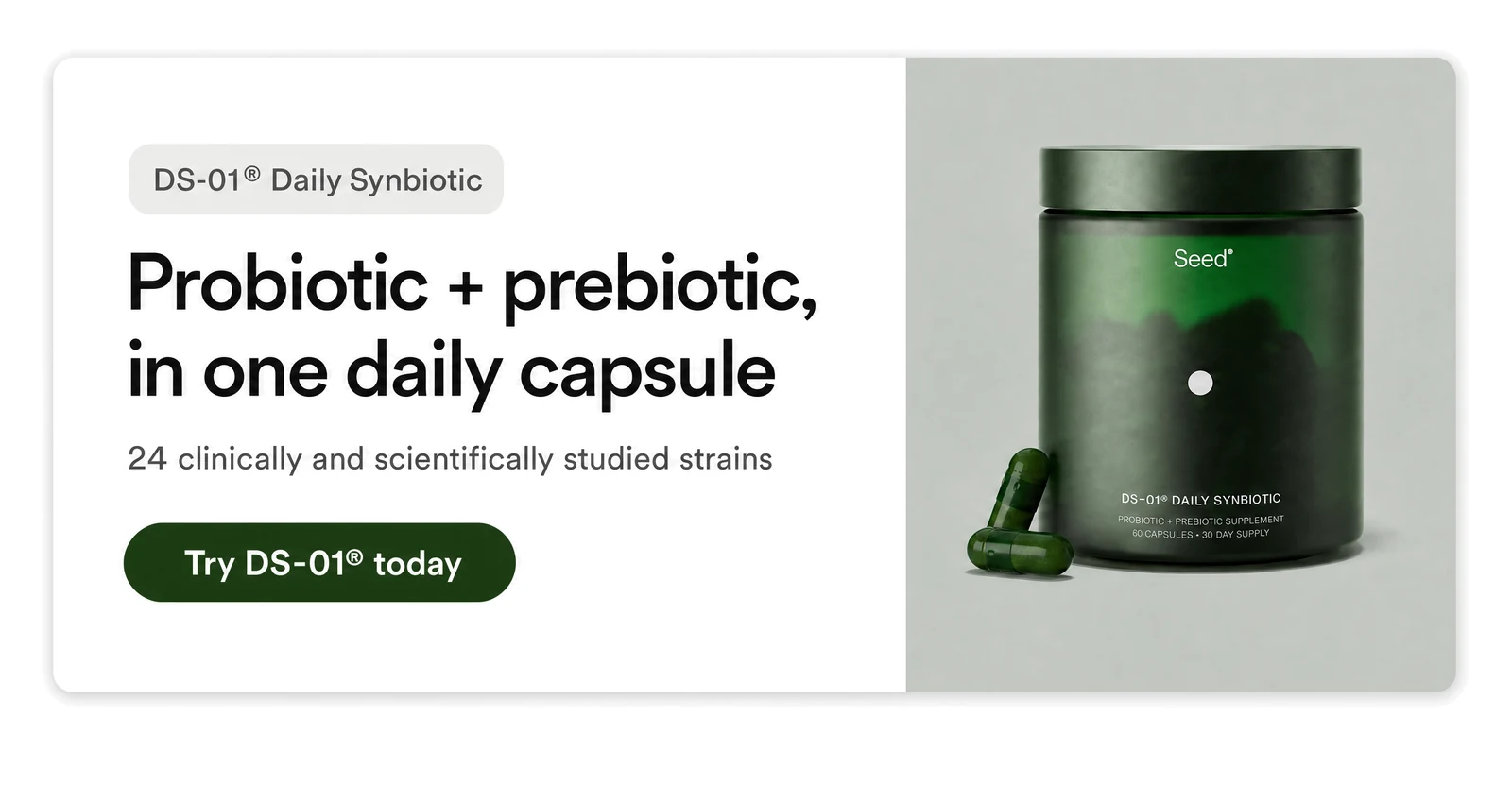
DS-01® Daily Synbiotic is clinically validated in the largest clinical trial for a probiotic on bloating + gas in healthy adults.°µ11 In that trial, DS-01® was clinically shown to reduce bloating + gas.°11 Its ViaCap® capsule-in-capsule design safeguards probiotics from stomach acid through digestion.
As with any addition to your routine, it’s a good idea to talk with your healthcare provider, especially if you’re pregnant, nursing, or managing a specific health condition.
Think of your gut microbiome less like a single system to fix and more like a garden that reshapes itself with the seasons of your life. The soil (your gut lining, your bacterial diversity) stays constant, but what grows best in it changes as your hormones shift from puberty through menopause.
That’s the thread connecting everything here: the estrobolome recycling estrogen during your cycle, the microbiome shifting to support pregnancy, and gut bacteria changing composition after menopause. None of these are separate problems to solve. They’re the same underlying relationship between your hormones and your microbes, showing up differently depending on where you are in life.
You don’t need to overhaul your routine every time your hormones shift. A diverse, plant-rich diet, consistent stress management, quality sleep, and a clinically studied probiotic can travel with you through every stage, adjusting to what your gut needs most at the time.
🌱 Your gut has been quietly adapting to your hormones your whole life. Tending to it consistently is how you help it keep doing that well.
A diverse, fiber-rich diet is the most consistent foundation. Women’s gut health is also shaped by stress, sleep, and life stage, so there’s no single fix, but research consistently points to plant diversity as the strongest lever.8
Aim for a wide variety of fruits, vegetables, legumes, whole grains, nuts, and seeds, which feed different species of beneficial bacteria. Managing stress and prioritizing sleep also support the gut-brain axis, especially during hormonally active periods. For targeted support, a clinically studied probiotic with strains shown to support regularity and reduce bloating can be worth considering.
Focus on consistent daily habits, not a dramatic reset. Start by increasing the diversity of plant foods in your diet. Reducing highly processed foods high in sugar and managing stress can also make a noticeable difference.
Fermented foods like yogurt, kimchi, and sauerkraut are nutritious additions that may contribute live microorganisms to your diet.9 If you’re experiencing persistent symptoms like bloating, irregular digestion, or discomfort that tracks with your menstrual cycle or a life transition, talk to a healthcare provider who can help identify what’s going on.
Ongoing bloating and gas, or occasional constipation or diarrhea. For women, gut health symptoms can also show up in less obvious ways: mood changes, fatigue, skin issues, and food sensitivities that seem to come and go with your cycle. Bloating that worsens before your period, occasional constipation during pregnancy, or new digestive patterns during perimenopause are all signals that your gut microbiome may be shifting. Occasional symptoms are normal, but if they’re persistent or interfering with your daily life, check in with your doctor.
° These statements have not been evaluated by the Food and Drug Administration. This product is not intended to diagnose, treat, cure or prevent any disease.
µ As of February 2026.
°These statements have not been evaluated by the Food and Drug Administration. This product is not intended to diagnose, treat, cure, or prevent any disease.
µas of February 2026
*Based on a study conducted in SHIME®



Overview Walk down any wellness aisle, and you’ll be met with a wide selection of multivitamins for women. 💊 Bottles promise to support everything from energy to immunity, often categorized by age or life stage. The sheer volume of choice can feel overwhelming, doesn’t it? And it leads to an important question: What actually makes...
Overview When someone says ‘heart health supplement,’ you probably think omega-3s, maybe some garlic. Fair enough—those classics still matter. But researchers are discovering that supporting your heart health starts at the cellular level. Your heart contains more energy-producing mitochondria than any other organ—because pumping blood 24/7 takes serious fuel. (Think of it like running a...

Overview That first twinge of stiffness when you stand up after working at your desk, or the way your knee suddenly has opinions about the weather… Sound familiar? 😅 If you’re here, you’re probably wondering if there’s anything that actually works—or if joint supplements are just expensive hope in a bottle. Your skepticism makes sense....