Next Article
“Probiotic” Drinks: What They Are, What Actually Works, and What to Skip
8 minutes
L-glutamine is the primary fuel for your intestinal cells and supports the tight junction proteins that maintain gut barrier integrity. Learn what the research says about dosing, how it complements probiotics, and whether supplementation makes sense for your situation.

You’ve probably seen L-glutamine showing up everywhere lately. Powder scoops on TikTok, capsule stacks at the health food store, and a growing number of voices calling it the go-to for gut repair. So does any of it hold up?
Yes, there’s real science here. L-glutamine is a primary fuel source for enterocytes, the cells that line your intestinal wall.1 Your body relies on it to help maintain the protective barrier that keeps your gut functioning properly. 🦠
Your gut isn’t just a wall, though. It’s an entire ecosystem. L-glutamine helps maintain the structure, but it can’t tend to the trillions of microorganisms living inside it.
L-glutamine is the most abundant amino acid in your body. Under normal conditions, your body makes enough on its own. But during periods of illness, physical stress, or intense training, demand can outpace production, which is when dietary or supplemental sources start to matter.2
Your intestinal lining renews itself every four to five days. That’s an enormous amount of cellular turnover, and glutamine is the preferred fuel that drives it.1
You can think of the cells lining your gut like bricks in a wall. The “mortar” holding them together consists of tight junction proteins. Glutamine helps maintain the production and integrity of these proteins, keeping the barrier sealed and functioning.3
When glutamine levels drop, those tight junctions can weaken. That allows substances that would normally stay in the gut to pass more easily through the barrier, something researchers call increased intestinal permeability.4
Research also suggests glutamine may support the gut in two additional ways. It may help support the balance of the microbial community in the gut, and the body’s normal inflammatory responses, especially when the gut lining is under stress.5 Between fueling cells, holding the barrier together, and supporting healthy inflammation, glutamine is a useful player in gut health.
Still, a useful player isn’t a complete solution.
L-glutamine and probiotics get talked about in the same breath, but they’re doing two different jobs. Do you need both?
They work through entirely different mechanisms. L-glutamine is an amino acid that fuels the physical structure of your gut lining. Probiotics are live microorganisms that, when taken in adequate amounts, interact with your gut and immune cells to confer a health benefit.6
You can think of it like this: L-glutamine works on the gut’s physical infrastructure. Probiotics work on its biology. They influence the environment, produce useful compounds, and interact with systems throughout your body.
Dr. Dirk Gevers, Chief Scientific Officer at Seed Health, explains why this dual perspective matters. “We often think of cellular health in isolation, as if our human cells exist in a vacuum, but we are a composite organism. True systemic health requires us to consider the cellular needs of the host—you—alongside the nutritional needs of your microbiome. You can’t optimize one without considering the other.”
The research on combining them is encouraging. A 2023 clinical study looked at people with chronic intestinal inflammation and found that pairing probiotics with L-glutamine helped improve daily quality of life more than expected from either approach alone.7 An earlier animal study saw a similar pattern: glutamine and probiotics together calmed gut inflammation more effectively than either one by itself.8 That animal data still needs human confirmation, but it lines up with the broader picture.
L-glutamine can’t introduce new beneficial bacteria or reshape the composition of your microbial community. That’s a fundamentally different kind of support, and it’s what a clinically validated probiotic like DS-01® Daily Synbiotic is formulated to do: support both the gut microbiome and gut barrier integrity.°
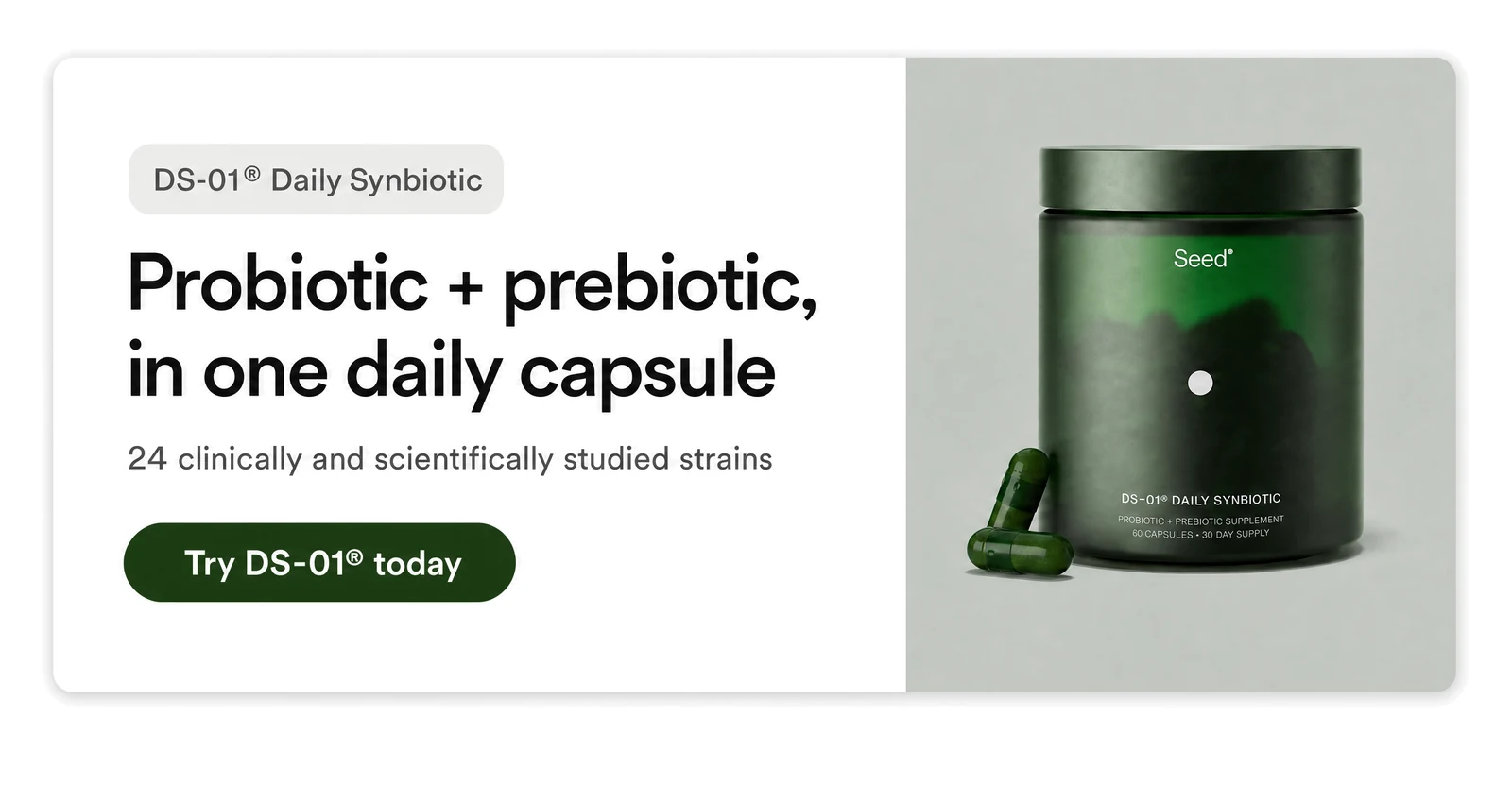
DS-01® Daily Synbiotic was clinically shown to improve regularity, reduce bloating and gas, and enhance digestive quality of life in a randomized, placebo-controlled clinical trial involving 350 healthy adults with self-reported bloating or indigestion°µ.9 Unlike L-glutamine, which primarily supports the gut lining itself, a synbiotic works through interactions with the gut microbiome.
The takeaway isn’t to pick one or the other. L-glutamine and probiotics offer tools to address your gut from two different directions, and a layered approach may provide the most complete support.
If you’re considering L-glutamine for gut health, dosing matters, and context matters even more. Most clinical studies on glutamine for digestive conditions have used doses between 5 and 15 grams per day.10,11
One of the most cited trials is a randomized, placebo-controlled study on people with chronic digestive issues following a gastrointestinal (GI) infection, who also showed increased intestinal permeability. Participants took 5 grams of L-glutamine three times daily (15 grams total) for eight weeks. About 80% achieved a meaningful reduction in digestive symptom severity scores, and intestinal permeability was normalized in the glutamine group compared to placebo.10
Another trial found that glutamine paired with a low FODMAP diet produced better outcomes than diet alone. In that study, 88% of participants in the glutamine group improved, compared to 60% in the control group.11
Most studies show effects within two to eight weeks of consistent daily use. That said, your results will vary depending on your starting point and overall health. The evidence is strongest for people with existing digestive issues, not for generally healthy adults whose bodies already produce adequate glutamine on their own.
As for form, L-glutamine appears to be efficiently absorbed when taken orally, but powder tends to be more practical at higher doses. Research suggests it’s absorbed well and mixes easily into water or a smoothie.12 If you’re trying capsules, be prepared to take quite a few to hit the doses used in research.
Not everyone needs extra L-glutamine. Your body makes it naturally, and you also get it from protein-rich foods like chicken, fish, eggs, dairy, beans, tofu, and spinach. A typical diet provides around 3 to 6 grams per day, which is usually enough for most healthy adults.2
Supplementation tends to make the most sense when your body’s demand outpaces production. That includes periods of physical stress, recovery from illness, intense athletic training, or diagnosed digestive conditions.2
If you do try it, L-glutamine is generally well-tolerated at standard doses. That said, people with preexisting conditions should talk to a healthcare provider before starting.1
L-glutamine has its place, but it works best as part of a broader strategy. Pairing it with a balanced diet and targeted probiotic support addresses your gut from multiple angles, structural and microbial. And whatever your situation, it’s always worth having a conversation with your doctor, especially if you’re managing a specific condition or taking other medications.
Think of your gut like an orchard. L-glutamine is the soil and the trees themselves — the physical setup that holds everything together. The microbiome is the buzzing life around it: the bees doing the pollinating, the worms working the soil, the everyday activity that actually turns trees into fruit. Healthy trees with nothing buzzing around them produce very little. All that life with no healthy trees has nowhere to land.
Your gut doesn’t ask you to choose between a strong lining and a thriving microbiome. Your gut health is something you cultivate, root and all. 🌱
Not exactly — but it fuels the cells that maintain it. L-glutamine feeds the cells lining your intestinal wall and supports the tight junction proteins holding that lining together.3 Research suggests it may help reduce intestinal permeability, particularly in people whose glutamine levels are depleted from stress, illness, or intense exercise.4
For healthy people with balanced diets, your body typically produces enough on its own. It’s less about “healing” and more about giving your gut lining the raw materials it needs to maintain itself under demanding conditions.
Clinical trials have used 5 to 15 grams per day, though that range was studied in people with diagnosed digestive conditions — not healthy adults. One randomized controlled trial used 5 grams three times daily (15 grams total) for eight weeks in people whose digestive symptoms began after a gut infection. The majority of participants improved, and intestinal permeability normalized in the glutamine group.10
Healthy adults typically get 3 to 6 grams of glutamine daily from a protein-rich diet, which is usually enough.2 If you do supplement, powder form tends to be more practical at therapeutic doses. Check with your healthcare provider to find the right dose for your situation.
Yes — and research suggests they may work better as a pair. L-glutamine and probiotics address gut health through different mechanisms. Glutamine supports the physical structure of your gut lining, while probiotics are live organisms that interact with your microbial ecosystem and immune system.6
Animal studies have shown that combining probiotics with glutamine can reduce intestinal inflammation more effectively than either approach alone.8 They’re complementary, not competing. Taking both is a reasonable strategy for supporting your gut from multiple angles, and probiotics like DS-01® Daily Synbiotic are designed to work alongside the structural support glutamine provides.°
Most studies show effects within two to eight weeks of consistent daily use. In one clinical trial, trial participants with chronic digestive issues who took 15 grams daily saw normalized intestinal permeability at the eight-week mark.10 Another study that combined glutamine with dietary changes saw improvements even sooner.11
Results depend on your starting point, dose, and overall health. Consistency matters, and pairing glutamine with other gut-supportive strategies, like a clinically validated probiotic, can help support your gut more comprehensively.
°These statements have not been evaluated by the Food and Drug Administration. This product is not intended to diagnose, treat, cure, or prevent any disease.
µ as of February 2026

Overview Bloating, unpredictable digestion, brain fog after meals—it’s no surprise your search history includes “best gut health supplement,” or that the wellness aisle of your local drugstore is packed with powders and pills that promise to fix your microbiome. But here’s where it gets interesting: gut support isn’t about chasing a miracle capsule. It’s about...

You've started taking probiotics, and now you're wondering: "Are they actually doing anything?"
In the last two decades, scientific exploration into the microbiome has skyrocketed, with over $1.7 billion spent on human microbiome research since 2009. 1 Advancements in sequencing technology empowered discoveries that elucidate the microbiome’s critical role in health and disease, charted the development of the infant microbiome, and have even begun to define how our...