Next Article
Fermented Foods for Gut Health: How to Get Real Benefits From Every Bite
9 minutes
Apple cider vinegar gets a lot of credit for gut health, but the science tells a more nuanced story. Learn what ACV can and can't do for your microbiome, the difference between fermentation byproducts and clinically studied probiotics, and what the evidence says about meaningful digestive support.

Apple cider vinegar contains acetic acid, trace bacteria left over from fermentation, and a small amount of polyphenols from the original apples. Most of the gut health claims around it lean on extrapolations from those ingredients rather than direct research.
A morning shot won’t necessarily reset your microbiome. The bacteria in the bottle aren’t the same as clinically studied probiotic strains. And the “prebiotic” framing leans on science that doesn’t translate neatly to vinegar. 🍎
When it comes to apple cider vinegar for gut health, what’s documented and what’s claimed are two different conversations. Here’s where the evidence actually lands, what your gut responds to, and what’s worth keeping ACV around for.
Apple cider vinegar starts as apple juice. Yeast converts the sugars into alcohol, and a type of bacteria from the Acetobacter genus converts that alcohol into acetic acid. That’s the fermentation process in a nutshell, and it’s the same basic chemistry behind any vinegar.
Raw, unfiltered ACV contains what’s often called “the mother,” a cloudy collection of bacteria and yeast left over from fermentation. The idea is that the mother contains probiotics, and probiotics support gut health, so ACV must do the same.
The bacteria in ACV are fermentation byproducts, primarily Acetobacter genus. Research has explored their potential for microbiome benefits.1 But a probiotic, by definition, is a live microorganism shown in adequate amounts to provide a health benefit.2 Containing bacteria isn’t enough; those bacteria must arrive alive in dose-appropriate numbers and have demonstrated benefits in research.
ACV also contains acetic acid, trace polyphenols from the original apples, and very small amounts of minerals.3
If there’s one area where ACV has research behind it, it’s blood sugar. A meta-analysis of clinical studies found that consuming ACV may modestly reduce fasting blood glucose, though the effects are small and the mechanism isn’t fully understood.4 A randomized trial also reported improvements in fasting glucose and other glycemic indices, with similarly modest effect sizes.5
Another trial reported modest reductions in weight, BMI, and waist circumference with ACV intake, though findings varied considerably and several included diet and exercise interventions alongside ACV.6
You’ll often see ACV described as having “prebiotic properties.” That claim deserves a closer look.
A prebiotic is a substance that selectively feeds beneficial microorganisms in your gut.7 Classic examples are inulin, fructooligosaccharides (FOS), and galactooligosaccharides (GOS): compounds that pass through your upper digestive tract undigested and get fermented by your gut bacteria in the colon. That fermentation produces short-chain fatty acids (SCFAs) like butyrate, which fuel your intestinal cells and support gut barrier integrity.8,9
Acetic acid is itself a short-chain fatty acid, but when you consume it in ACV, it tends to be rapidly absorbed in the upper digestive tract, well before it could reach the colon to feed your gut bacteria.10 The tiny amount of pectin (a soluble fiber from the original apples) that might remain in ACV after fermentation is negligible compared to what you’d get from eating an actual apple.
Polyphenols are a different kind of prebiotic that can support the gut microbiome. Apple vinegar can contain a range of polyphenolic compounds with diverse and complex compositions.3 Whether the modest amounts in a daily tablespoon translate into meaningful microbiome effects remains an open question.
Acetic acid has been studied for its antimicrobial properties. In lab and food safety studies, it can inhibit the growth of certain bacteria on surfaces.11,12 That can be useful in the kitchen, but it isn’t a replacement for proper food safety practices.
The idea that this surface-level antimicrobial activity translates to “balancing” your internal gut microbiome is a stretch. Your stomach already produces hydrochloric acid at a pH of 1.5 to 3.5, far more acidic than vinegar’s pH of 2.5 to 3.0. A teaspoon of vinegar isn’t going to reshape what’s happening in your colon.
If you’re drawn to apple cider vinegar because your digestion feels off, that instinct is worth paying attention to. Bloating, irregularity, and general digestive discomfort can have many causes: diet, stress, sleep, hydration, medications, and underlying health conditions all play a role. Your gut microbiome is one factor; when the balance of microbes shifts, it can affect digestion, motility, and how your gut feels day to day. But occasional symptoms don’t automatically mean probiotics are the answer; they’re a signal worth investigating.
The research on what supports microbiome composition and helps maintain normal digestive function points to a few specific tools.
Not all bacteria are created equal. Benefits are assessed at the strain level, which means different probiotic strains offer different effects. Bifidobacterium longum BB536, for example, is a probiotic that’s been isolated from the human gut and added to functional foods or supplements; it has different documented effects than Bifidobacterium longum found in fermented foods. Research on B. longum BB536 specifically has shown it supports improvements in intestinal environment, defecation frequency, and fecal characteristics.13 Other studied strains, such as L. plantarum LP01, B. breve BR03, and B. lactis BS01, have been examined in controlled trials for their effects on bowel regularity, stool consistency, and ease of evacuation in adults with occasional irregularity.14
Short-chain fatty acids are fuel for your colon cells, and they play a role in maintaining gut barrier function and supporting gut immune health. In a lab model of the gut microbiome, a multi-strain synbiotic formulation was associated with increased production of short-chain fatty acids, including butyrate and acetate, which may contribute to a healthy intestinal environment during recovery after disruption.16
👉 TL;DR: Strain specificity, an effective dose, and surviving the trip to the colon are what actually account for probiotic benefits.
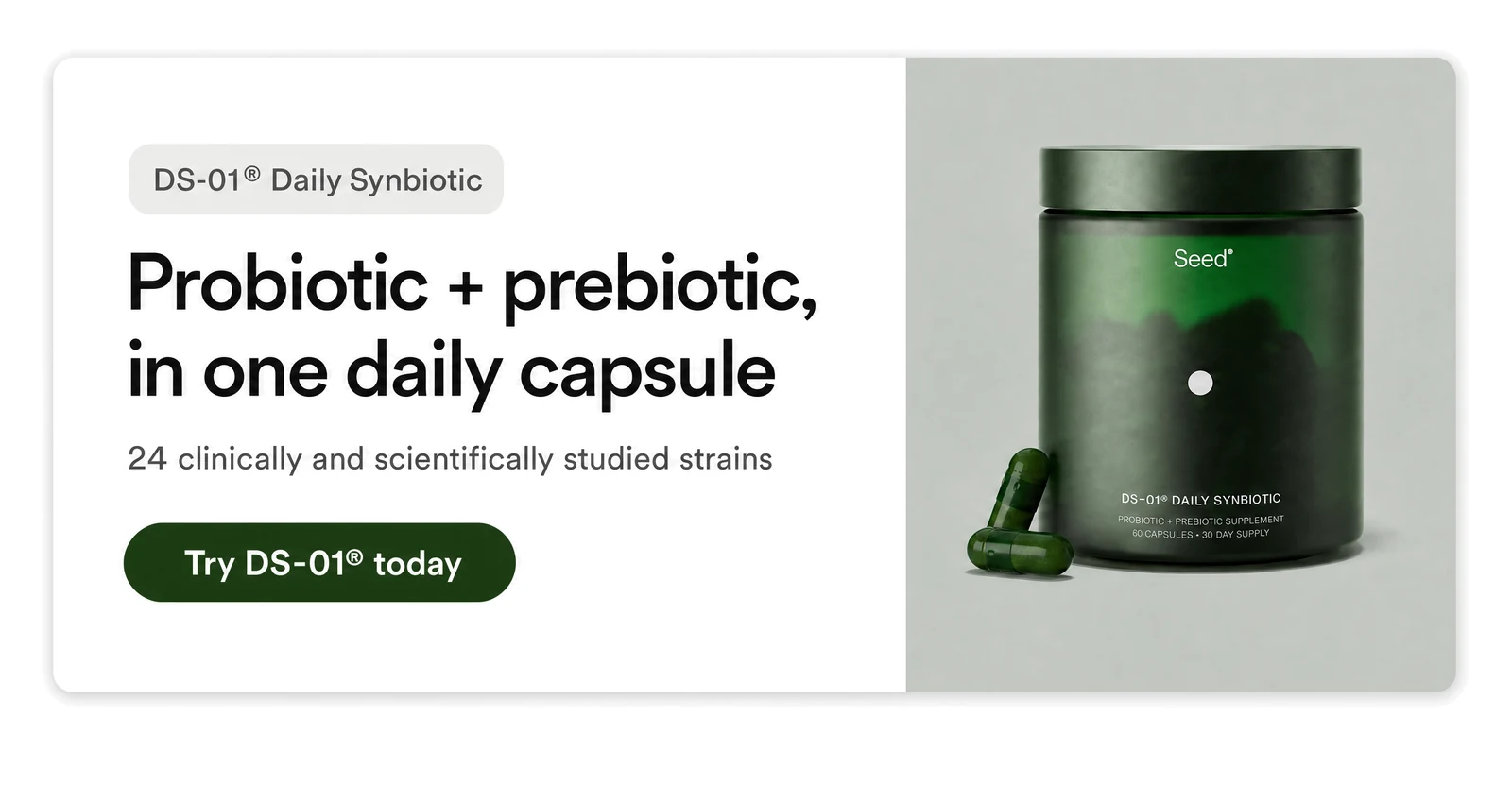
DS-01® Daily Synbiotic is a 2-in-1 probiotic and prebiotic that’s clinically validated in the largest clinical trial for a probiotic on bloating + gas in healthy adults.°µ19 It increases beneficial bacteria in the gut microbiome.° Its ViaCap® capsule-in-capsule design safeguards probiotics from stomach acid through digestion.
There’s nothing wrong with enjoying apple cider vinegar. It adds a nice tang to dressings and marinades, and in small amounts it’s generally safe for most people. A few things to keep in mind:
Apple cider vinegar is better as a condiment, than a cultivator. Acetic acid is primarily absorbed in the upper digestive tract, the antimicrobial activity tested in food settings doesn’t necessarily reach where most of your microbes actually live, and the bacteria from fermentation aren’t the kind that have been rigorously studied or dosed for gut benefit. Essentially, ACV isn’t validated to show up where most of your microbiome resides.
🌱 Essentially, your microbiome grows from what reaches it.
Not in any meaningful clinical sense. ACV doesn’t “clear” your gut, and your gut doesn’t need clearing. What your digestive system relies on is a diverse, balanced microbiome with bacteria that support digestion, barrier function, and immune signaling. While ACV contains trace microbes from fermentation, there’s no guarantee those bacteria reach the colon alive, where most of your gut bacteria reside.1 If you’re experiencing bloating or irregularity, those symptoms are worth discussing with a healthcare provider rather than self-treating with vinegar.
Probably nothing dramatic, in small diluted amounts. Some research suggests modest blood sugar effects, especially when ACV is consumed with meals.4 The viral claims about ACV “resetting” your gut or “detoxing” your system aren’t supported by clinical research. Undiluted shots can erode tooth enamel and irritate your esophagus.17 If you do drink it, dilute it well in water and rinse your mouth afterward.
Mostly no, at least not the way the wellness internet frames it. ACV has modest evidence for blood sugar effects and antimicrobial activity in food settings, but research on direct gut microbiome benefits in humans is thin.4 The trace bacteria from fermentation aren’t the same as clinically studied probiotic strains delivered in adequate amounts.2 For evidence-based microbiome support, the research points toward specific probiotic strains, prebiotic fiber, and a diverse plant-rich diet.7
° These statements have not been evaluated by the Food and Drug Administration. This product is not intended to diagnose, treat, cure or prevent any disease.
µ As of February 2026.


Overview Bloating, unpredictable digestion, brain fog after meals—it’s no surprise your search history includes “best gut health supplement,” or that the wellness aisle of your local drugstore is packed with powders and pills that promise to fix your microbiome. But here’s where it gets interesting: gut support isn’t about chasing a miracle capsule. It’s about...

Overview Have you ever tossed yogurt or a bottle of kombucha into your cart just because the label promised “probiotics”? 🛒 You’re not the only one. But what if this isn’t the best approach? With so many foods advertising live cultures, it’s tempting to assume your gut is in good hands. Are all these so-called...

Overview What naturally kills bad bacteria in the gut? It’s a reasonable question, and a common one. Your gut doesn’t feel great, you’ve read that certain bacteria might be to blame, and you want something you can address through food and daily habits. Here’s the thing, though. The framing of that question (the idea that...