Next Article
The Best Yogurt for Gut Health: A Strain-by-Strain Guide
7 minutes
Kimchi is packed with live microbes, fiber, and bioactive compounds that may support your gut. But there's a catch: not all fermented foods qualify as probiotics. Here’s what the research says about kimchi and gut health—and how it may fit into a broader gut health strategy.

Kimchi has been a staple of Korean cuisine for centuries and shows up on nearly every “best foods for gut health” list today. The live microbes in it can support your digestive system. How much, which microbes, and whether kimchi can replace a probiotic are messier questions. 🦠
If you’re figuring out how fermented foods like kimchi fit into your gut-health routine, these distinctions matter.
Kimchi starts with vegetables (usually napa cabbage and radish), seasoned with garlic, ginger, scallions, and gochugaru (Korean chili flakes). Fermentation does the rest.
During fermentation, bacteria already on the vegetables (primarily Lactobacillus species) convert sugars into lactic acid. That gives kimchi its tangy flavor and creates an environment where beneficial bacteria thrive.1
But microbes are only part of the picture. Kimchi is also rich in dietary fiber, which feeds your existing gut bacteria, plus bioactive compounds from the garlic, ginger, and chili peppers. One of those compounds, HDMPPA, has shown anti-inflammatory properties in early research.2
A serving also delivers vitamins A, C, and K, B vitamins, and minerals like iron and potassium, all in a low-calorie, high-fiber package.
The question is what happens once those microbes hit your digestive system.
The research is compelling, though it’s also an evolving area of study with plenty still being explored.
A landmark Stanford study found that people who ate fermented foods daily for 10 weeks had more diverse gut microbiomes and lower levels of 19 inflammatory proteins.3 Greater microbial diversity is generally linked to better overall health.4
A 2024 study focused specifically on kimchi found that regular consumption increased Akkermansia muciniphila, a species associated with a healthy gut lining, while reducing potentially harmful Proteobacteria.5
Kimchi may also affect your immune system. A 2025 trial found that 12 weeks of kimchi consumption helped immune cells communicate and respond more efficiently in overweight adults.6 Another 4 week trial found that daily kimchi consumption did not significantly change markers of immune function—suggesting short-term intake may not meaningfully impact immune activity in already healthy individuals.7
Kimchi’s anti-inflammatory potential lines up with research on HDMPPA, a bioactive compound formed during fermentation that may help manage inflammatory responses in the gut.2
A randomized trial found that kimchi consumption improved glucose metabolism and body weight in those with metabolic challenges.8 A large observational study found that men eating one to three servings of kimchi daily had a 10% lower risk of weight gain.9
A few caveats: many of these studies are small or focused on specific populations, and the type, amount, and preparation of kimchi all vary.
Kimchi isn’t a probiotic, despite the two getting linked together constantly.
The International Scientific Association for Probiotics and Prebiotics (ISAPP) defines probiotics as “live microorganisms that, when administered in adequate amounts, confer a health benefit on the host.”10 The microbes need to be alive, present in a known amount, and have a demonstrated health benefit at that dose.
Kimchi has the first one covered. The other two are harder. Strains and quantities in any given batch depend on the vegetables, fermentation time, temperature, storage conditions, and brand.11
Dr. Dirk Gevers, Ph.D., Chief Scientific Officer at Seed Health, frames it this way: “When we talk about the benefits of a probiotic, we’re talking about specific strains studied at specific doses. Fermented foods are a valuable part of a healthy diet, but the microbes they contain haven’t usually been characterized and studied the way clinically validated probiotic strains have.”
That doesn’t make kimchi useless. ISAPP has defined a separate category for foods like kimchi: “live dietary microbes.”11 These are microorganisms in food that may contribute to health without meeting the stricter definition of a probiotic.
For more precision, clinically studied probiotics offer something kimchi can’t: identified strains at known doses with documented effects.
DS-01® Daily Synbiotic combines 24 probiotic strains, including Bifidobacterium breve SD-BR3-IT and Lactiplantibacillus plantarum SD-LP1-IT, both studied for healthy regularity, including improvements in bowel movement frequency and stool consistency.12
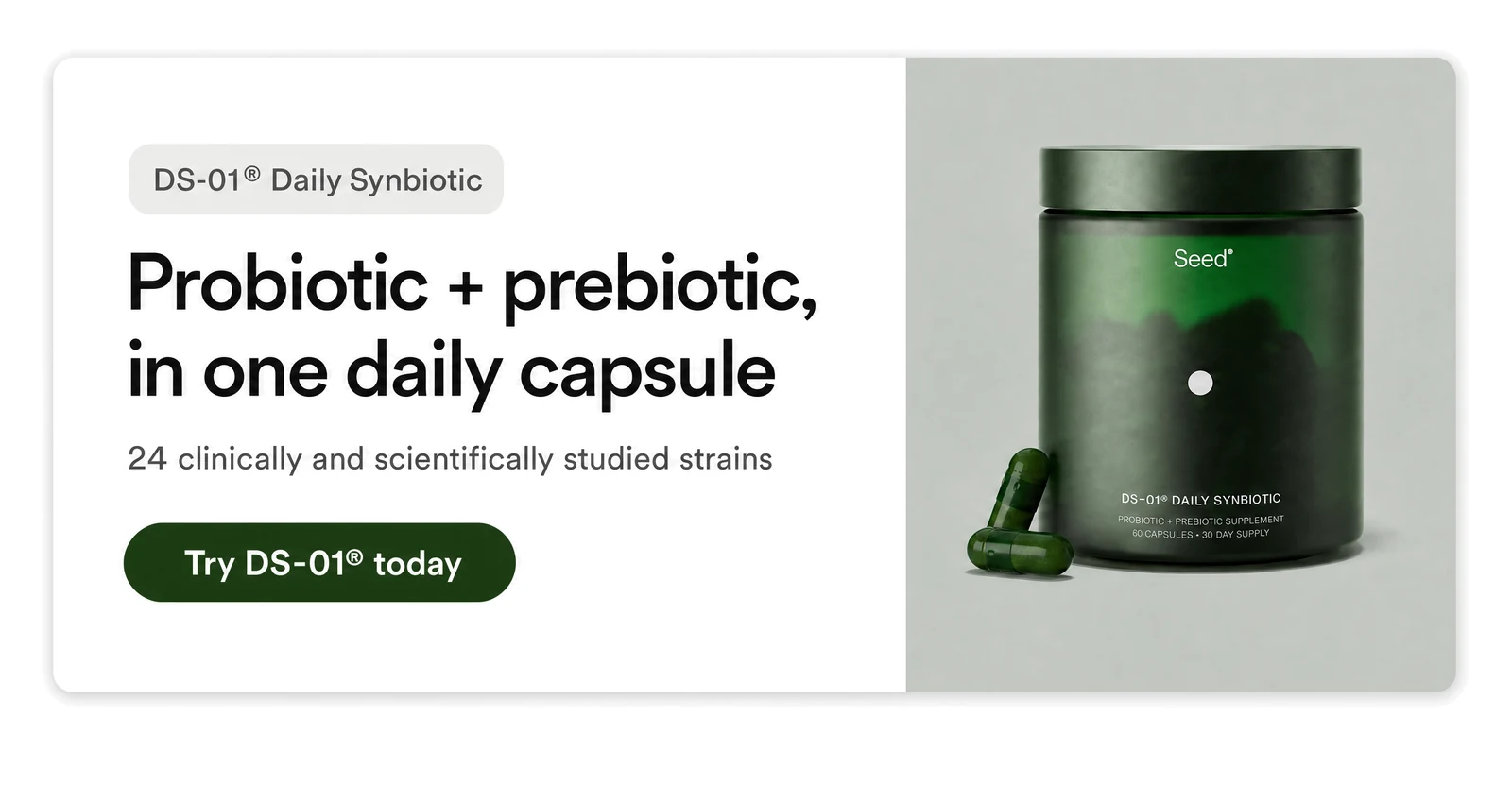
The strains are delivered via ViaCap®, a nested capsule-in-capsule system designed to protect viability through digestion and release in the colon. In a randomized, placebo-controlled trial of 350 healthy men and women, DS-01® improved regularity, reduced bloating, and eased gas.13
Kimchi can add microbial variety (along with fibers, bioactive compounds, and vitamins), while a targeted probiotic adds precision. Depending on your goals, and how many supplements you’d like to take, either or both can have a place in your routine.
A few practical notes for making kimchi part of your routine.
Most research uses portions of about 100 to 300 grams per day, roughly a half cup to a cup and a half.5,6 Start small and build up, especially if you’re new to fermented foods. Some initial bloating or gas can be normal as your gut adjusts.
Pasteurized kimchi (the shelf-stable kind) has been heat-treated, which kills most of the live microbes. Look for refrigerated, unpasteurized kimchi labeled “live and active cultures.”
Kimchi can be high in sodium: one cup can contain 800 mg or more, depending on the recipe.9 If that’s a concern, look for lower-sodium varieties or balance your intake with other low-sodium foods throughout the day.
No single food can do everything your microbiome needs. A diverse, fiber-rich diet paired with consistent sleep, movement, and stress management does more than any one ingredient. Kimchi can complement other beneficial lifestyle habits that support overall gut and whole-body health.
For more specific support, a targeted probiotic like DS-01® Daily Synbiotic is another option — it contains 24 scientifically studied probiotic strains not commonly found in foods, yogurts, or beverages.
💡 Pro Tip: Chat with your doctor if you have underlying digestive concerns or are wondering which foods or products may best support your gut health routine.
Think of your gut as a garden. Kimchi is one of the more nutrient-dense things you can plant in it: live microbes, prebiotic fiber, and bioactive compounds. Research connects it to microbial diversity, lower inflammation, and better metabolic markers.
The honest answer to “is kimchi good for gut health?” comes with a footnote. The bacteria are generally uncharacterized and haven’t been studied at specific doses for specific outcomes. None of that is a reason to skip kimchi. It’s a reason to treat it as one input, not the whole strategy.
A diverse diet, consistent habits, and a willingness to pay attention to your own digestion will get you further than any single food. Kimchi is a strong place to start. If you want more targeted support, a clinically studied probiotic is another option worth considering.
Variety, consistency, and a little patience — that’s what your microbiome grows on. 🌱
Yes, with caveats. Kimchi contains live microbes, dietary fiber, and bioactive compounds that can support a healthier microbial environment. Research links daily fermented food consumption to greater microbial diversity and lower levels of inflammatory proteins.3 But kimchi isn’t a probiotic in the technical sense. Strains and doses vary from batch to batch, so the benefits aren’t guaranteed the way they are with clinically studied probiotic strains.11
No, not really. Kimchi doesn’t “clean out” your gut the way some wellness products claim to. Your liver, kidneys, and colon already handle that. What kimchi can do is support a healthier microbial environment in your digestive tract. Its live bacteria may encourage beneficial microbes, and its fiber helps keep things moving.1
100 to 300 grams per day — roughly half a cup to a cup and a half.5,6 That’s the range most research uses. Consistency matters more than quantity. Eating a small amount of kimchi regularly is likely more beneficial than eating a large amount once in a while. If you’re new to fermented foods, start with a few tablespoons a day and gradually increase. Some initial digestive adjustment (mild bloating or gas) is normal and usually settles within a week or two.
They serve different purposes. Kimchi contains live microbes, but the strains, quantities, and viability vary from batch to batch.11 A clinically studied probiotic like DS-01® Daily Synbiotic contains identified strains at specific, studied doses with documented benefits.12 Kimchi gives you dietary diversity and fiber; a targeted probiotic delivers strain-specific support. The right choice depends on your goals.



Overview Have you ever tossed yogurt or a bottle of kombucha into your cart just because the label promised “probiotics”? 🛒 You’re not the only one. But what if this isn’t the best approach? With so many foods advertising live cultures, it’s tempting to assume your gut is in good hands. Are all these so-called...

Strategies for supporting digestive health beyond diet—from regulating your sleep timing to exploring your local park.
Overview Bloating, unpredictable digestion, brain fog after meals—it’s no surprise your search history includes “best gut health supplement,” or that the wellness aisle of your local drugstore is packed with powders and pills that promise to fix your microbiome. But here’s where it gets interesting: gut support isn’t about chasing a miracle capsule. It’s about...