Next Article
No-Caff Nootropic Comparison: Seed’s AM-02, Noocube, or Mind Lab Pro?
10 minutes
Searching for the best sleep supplements? Start by letting go of the idea that you need “knockout” ingredients. See what the research says about melatonin dosing, how ashwagandha supports stress, and why the gut-brain axis (hello, GABA) matters for sleep quality—not just how long you sleep.
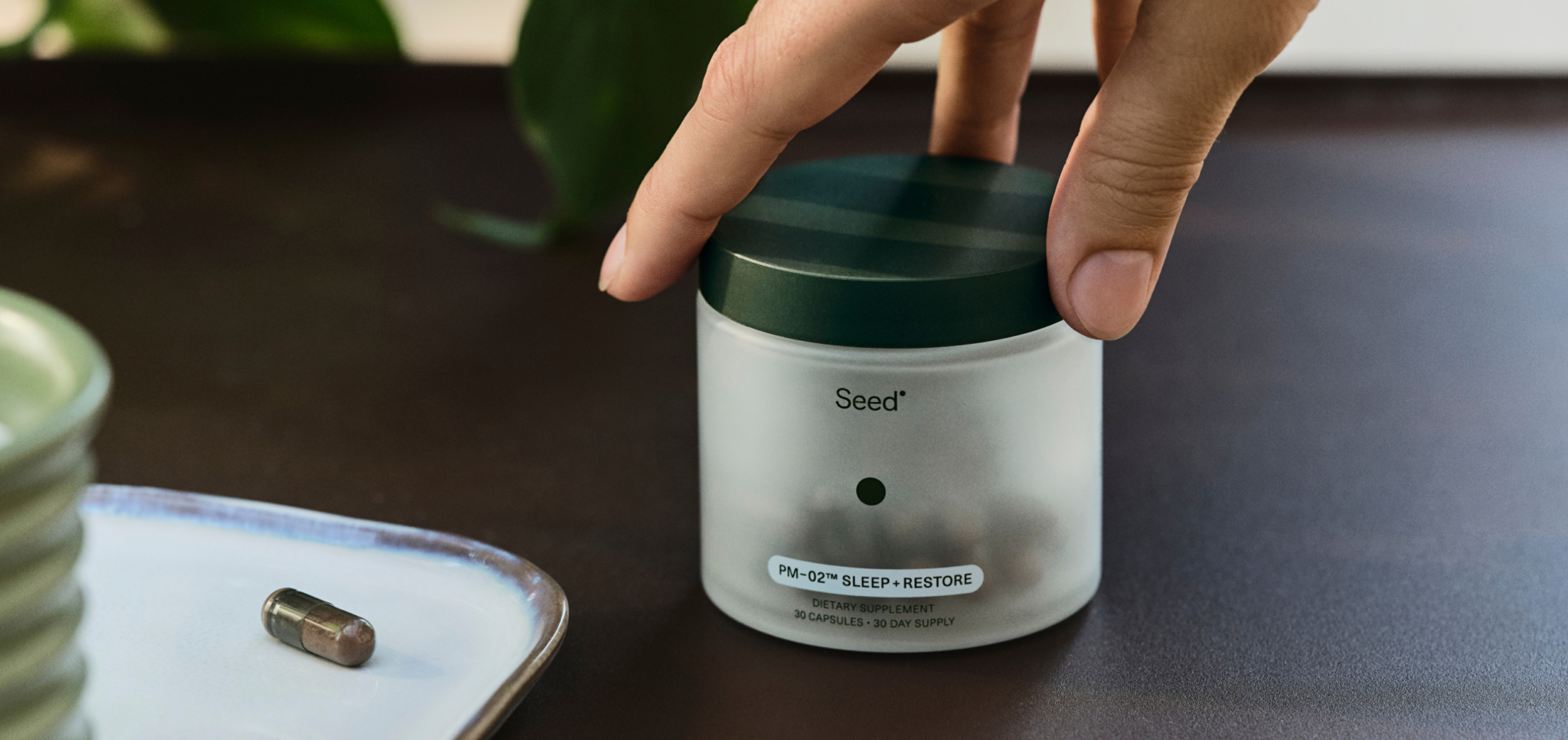
Melatonin doses have crept up—way up. What started as a 1mg tablet has ballooned into 5, 10, sometimes 20mg gummies promising to “knock you out”—and somehow, millions of people are still waking up groggy and unrested.
That disconnect points to something most roundups about the best supplements for sleep won’t mention: the problem usually isn’t that you need more. 💊 It’s that most sleep supplements are targeting the wrong thing—or targeting the right thing at the wrong dose. Falling asleep is only half the equation. The other half? Actually restoring while you’re out.
The science suggests that rather than hunting for the strongest sedative, the better approach involves understanding your body’s biology—your circadian rhythm, your stress hormones, and even your gut microbiome. True sleep health isn’t about sedation; it’s about supporting your body’s restoration overnight.
Here’s what the evidence actually says about the best supplements for sleep—and how to use them to not just fall asleep, but to truly rest.
When you ask about the best sleep supplements online, melatonin is usually the first recommendation that pops up in the comments. It’s the most researched option for a reason—studies consistently show that melatonin supplementation can improve sleep quality and reduce the time it takes to fall asleep.1,2
But there’s a common misconception worth clearing up. 🎤
Melatonin isn’t a sedative in the traditional sense. It’s a hormone that signals to your body that it’s time to wind down. Think of it as a conductor tapping the baton—it doesn’t play the music, it tells the orchestra (your cells) when the evening performance is starting.
🔬 Science Translation: Melatonin doesn’t knock you out. It tells your brain, “Hey, it’s nighttime now!” Your body still has to do the actual work of falling asleep. That’s why flooding your system with massive doses doesn’t necessarily help—and can actually backfire.
Walk into any pharmacy and you’ll find melatonin supplements containing 3, 5, or even 10 milligrams (mg). The logic seems simple: if I really can’t sleep, I need the strong stuff. But biology doesn’t work that way.
Your body naturally produces very small amounts of melatonin—typically just a fraction of a milligram.3 When you flood your system with doses like 5–10mg, you’re delivering amounts that far exceed what the brain produces on its own. Some research suggests these higher levels may desensitize your melatonin receptors, although more human studies are needed.4
You could also experience next-day grogginess, vivid nightmares, or that “hungover” feeling that defeats the whole purpose. (Not exactly what you signed up for, right? 👎)
And those stats on the back of the bottle aren’t the only big numbers worth paying attention to. With 50 to 70 million Americans affected by sleep problems and more than 8% of adults regularly using sleep aids, a lot of people may be taking more melatonin than they need.5,6
Research confirms that physiological doses can be effective for improving sleep onset without these unwanted effects. One study found that just 0.3mg elevated melatonin to normal nighttime levels and improved sleep—without any “hangover” effects the next morning.7 PM-02™ uses 500mcg (0.5mg), which falls within this physiological range. This “bioidentical” approach respects your body’s natural rhythm rather than overloading it.
From a physiology standpoint, the issue is that many standard melatonin products don’t mirror the body’s natural secretion pattern. They’re often immediate-release, creating a sharp spike—while natural melatonin rises, peaks in the middle of the night, and tapers off toward morning. While some brands do offer extended-release formats, matching this natural curve takes more than just slowing things down.
For example, with PM-02™ Sleep + Restore, the release profile is the point. ☝️ It’s formulated with a dual-phase approach: It quickly releases melatonin to support falling asleep, then continues releasing it gradually over 7 hours to support staying asleep—without a big dose all at once that can leave you groggy the next morning.
Dr. Dirk Gevers, Seed’s Chief Scientific Officer, is a microbiome expert. He explains the philosophy behind bioidentical dosing. “The goal is not to override your sleep system. It is to support it,” he says. “When a supplement matches what the body naturally produces, it is working with millions of years of evolution, not against it.”
Sometimes the problem isn’t that you aren’t tired—it’s that you’re “tired but wired.” You lie down, close your eyes, and your brain immediately starts replaying every email you sent that week. (Sound familiar?) This is where Shoden® ashwagandha comes in, and why it’s quickly becoming recognized as one of the best supplements for sleep quality.
Ashwagandha is an adaptogen—a class of herbs that may help the body manage stress. Its strength lies in its ability to modulate cortisol, your body’s primary stress hormone.8
You can think of melatonin and cortisol as a seesaw; they work opposite each other. When melatonin rises and cortisol falls at night, you get restful sleep. When cortisol rises and melatonin falls in the morning, you wake up alert. But chronic stress can keep cortisol elevated in the evening, throwing off this balance and biologically blocking your sleep signals.9
Here’s the thing: sometimes the best thing you can do for your sleep isn’t to add a sleep signal—it’s to remove what’s blocking it.
Clinical studies on Shoden® ashwagandha have shown promising results. In one study, participants saw a 72% improvement in sleep quality compared to the control group.10 They fell asleep faster, woke up less during the night, and reported better physical and psychological well-being.
Research has also shown Shoden’s ability to lower cortisol levels—by as much as 66–67% in stressed individuals.11 By lowering the noise of stress, you aren’t just forcing sleep. You’re creating the physiological conditions that allow sleep to happen naturally. (Turns out, sometimes the best sleep hack is just… less stress.)
Your gut has a lot to say about how well you sleep. Turns out, the gut-brain connection extends well beyond digestion—and nowhere is this more evident than in the production of neurotransmitters like GABA (gamma-aminobutyric acid).12
GABA is your brain’s “brake pedal.” It slows down nerve activity and keeps the brain from becoming overexcited—which is exactly what you need when your mind won’t stop racing at midnight. Certain beneficial bacteria in your gut—like Lactobacillus and Bifidobacterium—can actually produce GABA.13 (Yes, your gut bacteria are literally making brain chemicals. Biology is so cool! 🤓)
The relationship between your gut and sleep runs both ways. Your microbiome helps produce and regulate key compounds—including precursors to serotonin and melatonin—that dictate your sleep-wake cycles.14 About 90–95% of your body’s serotonin (which converts to melatonin) is actually produced in your gut.12
Your gut bacteria also produce short-chain fatty acids (SCFAs) when they ferment fiber. These metabolites—especially butyrate—may influence circadian rhythms and pathways involved in sleep. Some research suggests that SCFA-associated signaling may play a role in serotonin and melatonin production.15 People with insomnia often show lower levels of these beneficial SCFA-producing bacteria.16
But the connection works in reverse, too. Poor sleep disrupts your gut microbiome, reducing microbial diversity and increasing inflammation.17 This creates a feedback loop: bad sleep leads to an unhealthy gut, which leads to even worse sleep. (And round and round it goes. 😵💫)
And that’s why sleep support formulas that target the gut-brain axis can be so effective. Supplements with GABA—especially forms like TechnoGABA™ that are fermented by Lactobacillus brevis—tap into this mechanism to promote relaxation.
👉 TL;DR: Your gut bacteria help produce the brain chemicals you need for sleep. When your gut is off, your sleep suffers—and when your sleep is off, your gut suffers. Breaking this cycle means supporting both.
When it comes to the best supplements for sleep, what you take matters—but so does how it reaches your system.
Most sleep supplements dump all their ingredients into your stomach at once, leaving absorption to chance. But the gut-brain axis requires targeted delivery. The ingredients that support you (like melatonin and ashwagandha) need to reach your bloodstream quickly. The ingredients that support your microbiome (like prebiotics and GABA) need to reach your lower gut intact.
This is where advanced delivery technology comes in. PM-02™ Sleep + Restore uses ViaCap®, a proprietary capsule-in-capsule system:
This two-layer approach helps ensure every ingredient arrives where it needs to work. With consistent use, the benefits may build over time—from faster sleep onset in the early weeks to more balanced cortisol levels and better-calibrated circadian rhythms with continued use.
While melatonin, ashwagandha, and even magnesium often get the headlines for sleep support, there are a few other nutrients that can help.
Glycine is an amino acid that may help promote relaxation by helping your body release heat—and a drop in body temperature is one of the biological signals for sleep. (Think of it as your body’s way of saying, “Time to cool down and power off.”) In human studies, taking glycine before bed has been shown to reduce next-day fatigue and improve how rested people feel.18
Often called the “sunshine vitamin,” vitamin D is ironically linked to how well you sleep at night. Deficiency has been associated with sleep disorders, and supplementation may improve sleep scores in those with low levels—though findings are mixed.19 Basically, it’s a supporting nutrient that helps keep the rest of the system running smoothly.
While most sleep advice focuses on the quantity of sleep (getting 8 hours), the real goal should be the quality of what happens during those hours. Sleep is an active state where your body repairs tissues and recharges cellular batteries.
PQQ (pyrroloquinoline quinone) supports the health of your mitochondria—the power plants of your cells. A study found that PQQ supplementation may improve sleep onset and maintenance while also reducing fatigue.20
🧠 Fun Fact: Your brain uses about 20% of your body’s total energy, which is why mitochondrial health can directly affect how restored you feel after a night’s sleep. (Learn more about the best vitamins and minerals for brain health here!)
The search for the best supplements for sleep can pull you toward one tempting idea: stronger must be better. But sleep isn’t a lock that needs a bigger key. It’s more like a garden—it needs the right conditions to grow.
Rather than overloading your body with mega-doses that can leave you groggy, the most effective approach works with your biology. Bioidentical melatonin (at a precise 500mcg dose) signals timing. Shoden® ashwagandha lowers cortisol to create the conditions for natural sleep. And GABA helps quiet the mind through the gut-brain axis. Together, they don’t override your body’s systems—they support them.
🌱 Better rest isn’t something you force—it’s something you cultivate, one well-supported night at a time.
There isn’t one single “most effective” sleep supplement—it depends on what’s actually keeping you up. Melatonin is the most direct option for regulating your sleep-wake cycle since it’s the hormone your body uses to signal sleep. But “effective” doesn’t mean you need a high dose. A bioidentical dose (500mcg) may actually work better long-term than mega-doses.
For stress-related sleep issues, Shoden® ashwagandha can help by lowering cortisol levels to allow natural sleep onset.
💡 Pro Tip: If you’re lying awake with a racing mind, stress management may be just as important as a sleep supplement. Look for formulas that address both timing (melatonin) and stress (ashwagandha).
Yes. Generally, herbal and natural sleep supplements are considered safe for most healthy adults, with fewer side effects than prescription sleep aids.21 That said, “natural” doesn’t mean “risk-free.” Interactions with medications can occur, and long-term safety varies by ingredient. Lower doses of melatonin (like 500mcg) tend to be well-tolerated with limited adverse or “hangover” effects.7
Always consult your doctor before starting a new regimen, especially if you’re pregnant, nursing, or managing a chronic condition. (Better safe than sorry—your doctor will appreciate you asking. 🙏)
For sleep quality—feeling restored rather than just unconscious—look for formulas that combine multiple mechanisms. Shoden® ashwagandha helps reduce cortisol, which may prevent those middle-of-the-night wake-ups. PQQ supports mitochondrial health, aiding the cellular repair processes that occur during deep sleep. And GABA promotes relaxation through the gut-brain axis.Rather than a single ingredient, the best approach targets both falling asleep and staying asleep—which is why dual-phase melatonin release and gut-brain support can make such a difference.


Overview The shelves are crowded with powders, gummies, and capsules all promising the same thing: a better night’s sleep. But if you’ve ever found yourself staring at the ceiling at 3 AM—or dragging yourself out of bed in a fog the next morning—you know that “sleep support” isn’t a one-size-fits-all label. 💊 The rise of...
Overview Finding the right sleep support can feel like a part-time job. One night you’re staring at the ceiling doing mental math (“If I fall asleep right now, I’ll get five hours and twelve minutes…”), and the next you’re groggy from a supplement that worked a little too well. 😴 It’s a frustrating cycle—you want...
Overview If you’ve walked into a room and forgotten why, searched for a word that won’t come, or felt afternoon brain fog, you’re not alone. 🧠 Your brain is energy-hungry—about 20% of total energy for just 2% of your body weight. It runs best on steady inputs: bioavailable vitamins and minerals, consistent sleep, stress management,...